
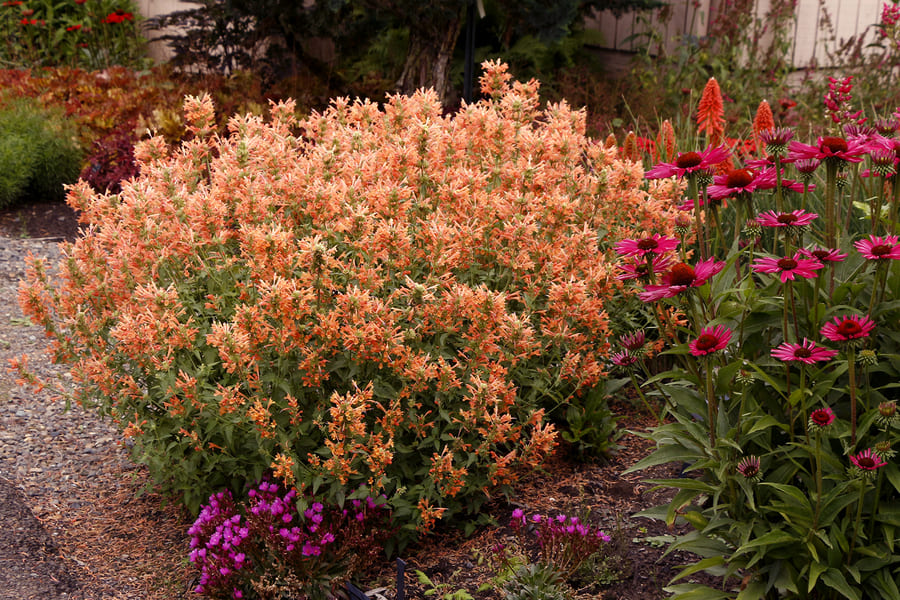
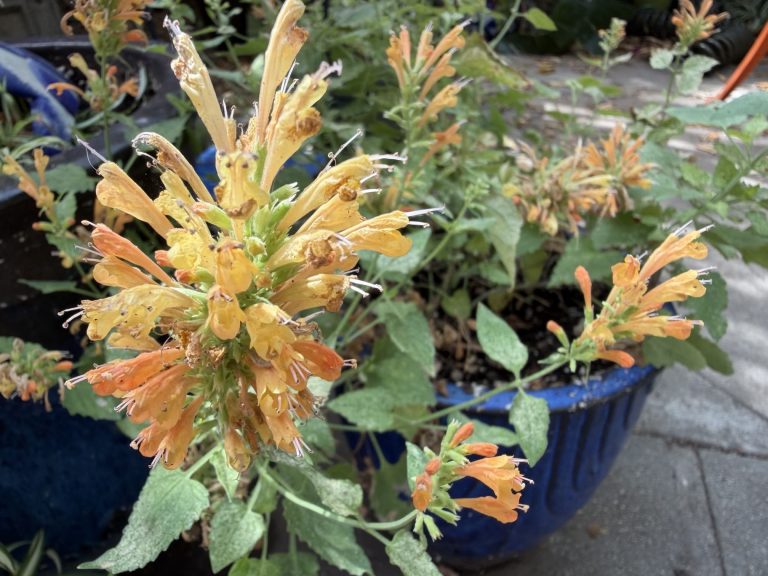
This past spring and summer, I grew two varieties of agastache from Terra Nova Nurseries—‘Prince’s Plume’ and ‘Peach Pearl’—in containers in my Southern California garden. Both rewarded me with an abundance of colorful flower spikes, fragrant foliage, and months of blooms.
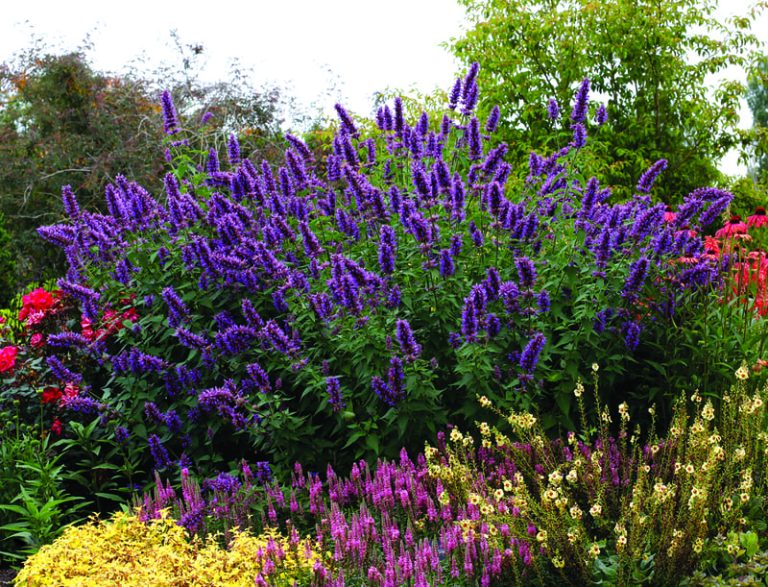
‘Prince’s Plume’ produces elegant purple flower spikes that rise above attractive foliage, while ‘Peach Pearl’ offers soft peach-colored blooms. Both have a distinctive licorice-like fragrance, thanks to their membership in the mint family, Lamiaceae.
Besides their beauty and fragrance, agastache offers another welcome benefit—its nectar-rich flowers attract hummingbirds and other pollinators.
And as I discovered during our intense August heat, these plants have a few growing preferences worth knowing about, especially when you’re gardening in containers.
Why Agastache Grows Well in Southern California
Agastache is particularly well suited to gardens in the American West. Many species originate in regions with warm, dry summers, making them natural candidates for Southern California landscapes.
According to Chuck Pavlich of Terra Nova Nurseries, the company’s breeding program incorporates species native to areas ranging from the Southwest deserts to the Cascade and Sierra mountain ranges, as well as parts of Idaho, Oregon, and Colorado.
The goal is to develop varieties with improved growth habits, disease resistance, flower color, and extended bloom periods.
Agastache also offers a long season of color. Pavlich says most Terra Nova varieties bloom from April through October, although the exact flowering period depends on the variety and growing conditions.
The two varieties in my garden have flowered throughout much of the summer and are continuing into fall.
Growing Agastache in Full Sun or Partial Shade
Agastache generally grows best with plenty of sunshine, but my experience this summer illustrates why it’s worth paying attention to individual growing conditions.
I’ve been growing Terra Nova’s ‘Prince’s Plume’ in a container in my courtyard, where it receives partial sun. It has performed beautifully, producing abundant purple flower spikes and attractive foliage.
I initially had ‘Peach Pearl’ growing in full sun. During our intense August heat, however, I noticed some of the foliage developing pale, whitish areas. I moved the container into a location with more shade, where it would receive protection from the strongest sunlight.
The foliage on ‘Prince’s Plume,’ which was already receiving some shade, remained in better condition.
Pavlich notes that most Terra Nova agastache varieties can thrive even in inland Southern California gardens when provided with appropriate growing conditions. He identifies hybrids with substantial Agastache rugosa ancestry, such as ‘Blue Boa,’ as a possible exception. This variety may perform better in milder coastal areas than in particularly hot inland locations.
For gardeners experiencing especially intense summer heat, my advice is to watch how your plants respond. While full sun is generally recommended, container-grown agastache may benefit from afternoon protection during particularly hot weather.
Soil, Watering, and Fertilizing
“Agastache are easy to grow if given the basics: well-drained soil, especially in the winter, plus plenty of sun, and a modicum of fertilizer,” says Pavlich.
Good drainage is one of the most important requirements for successfully growing Agastache. In garden beds, avoid locations where water collects or soil remains saturated for extended periods. If you have heavy clay soil, improving drainage is especially important.
For containers, choose a high-quality, well-draining potting mix and make sure the pot has adequate drainage holes.
Although agastache is drought tolerant once established, container-grown plants generally require more frequent watering than those growing in the ground. During hot weather, check the potting mix regularly and water when needed, allowing excess water to drain away. Avoid keeping the roots constantly wet, particularly during cooler winter weather.
Agastache doesn’t require heavy feeding. Pavlich recommends an organic or slow-release fertilizer formulated for perennials or bulbs when new growth appears in spring.
Choosing Agastache Varieties for Containers and Garden Beds
One of the appealing things about agastache is the range of sizes, colors, and growth habits available.
Terra Nova offers several varieties and series suited to different garden situations.
For containers:
- ‘Pink Pearl’ and ‘Peach Pearl’: Compact, full, rounded plants that work well in containers and garden beds.
- KUDOS™ Series: Medium-sized varieties suited to moderately sized containers.
- POQUITO™ Series: Smaller varieties that are especially useful where space is limited.
For garden beds and larger landscape displays:
- ‘Blue Boa’: An established variety known for its prominent flower spikes.
Another versatile choice is ‘Prince’s Plume’, a particularly floriferous selection with striking purple blooms and strong pollinator appeal. It grows well in both containers and garden beds.
Pavlich offers a memorable description of ‘Prince’s Plume.’
“‘Prince’s Plume’ is a monster bloomer and an incredible pollinator attractor; often the inflorescences are so heavy with bumbles that they hang down a bit and bob up and down as the bees come and go. Quite the sight!”
Although ‘Prince’s Plume’ is recommended for landscape use, I’ve found it also makes an impressive container specimen.
Agastache Attracts Hummingbirds and Other Pollinators
One of the greatest pleasures of growing agastache is the wildlife it attracts. The tubular flowers are particularly appealing to hummingbirds, which visit them for nectar. Bees and other pollinating insects also take advantage of the abundant blooms.
In my garden, the purple plumes of ‘Prince’s Plume’ are especially eye-catching. Their upright flower spikes add height and movement, while the flowers provide a food source for visiting pollinators.
For gardeners interested in creating a landscape that supports wildlife, agastache is a worthwhile addition.
Pests, Diseases, and Winter Care
Healthy agastache plants generally experience relatively few pest and disease problems. One concern is downy mildew, a disease that can affect agastache under favorable conditions.
Pavlich says Terra Nova has made mildew resistance a major priority in its breeding program. “Terra Nova took Downy Mildew (agastache’s nemesis) to heart and bred very mildew resistant varieties,” he says. Providing good air circulation and avoiding persistently wet conditions can also help maintain healthy plants.
Most Terra Nova agastache varieties develop a mounded to upright growth habit. As the growing season ends, they typically die back or enter dormancy before producing fresh growth in spring.
Pavlich recommends cutting Terra Nova varieties back to the ground in late fall or winter, with new growth emerging in early spring.
Because this is my first year growing ‘Prince’s Plume’ and ‘Peach Pearl,’ I’m interested to see exactly how they behave during our mild Southern California winter. Their seasonal growth patterns may differ from those of plants growing in colder climates.
A Colorful Addition to the Southern California Garden
After spending the summer growing ‘Prince’s Plume’ and ‘Peach Pearl,’ I can certainly understand the appeal of agastache. The flowers are beautiful and long-lasting, the foliage is fragrant, and the plants attract hummingbirds and other pollinators. With good drainage and attention to watering and sun exposure, they can make excellent additions to Southern California gardens. And those elegant flower spikes are reason enough to stop and take a closer look.