Portfolio Categories: ORANGEREVIEW.COM

Talk of The Towne OPLF Library Legacy Gala

Back in the late 1990s when the City of Orange Public Library Foundation (OPLF) formed to raise funds for pending library construction, those in the group decided that a gala would get the ball rolling. Their first event in 2004 highlighted a western theme, and the following year they hosted an “Orange Crate Cabaret.”

“The galas always feature fun themes, and they’re a real treat for everyone who attends,” says Priscilla Selman, secretary of the OPLF’s board and director of special events. She oversees the galas, including this year’s festivities to be held on the grounds of the new 210-acre Irvine Ranch Outdoor Education Center.

The wilderness-themed event on Sunday, April 22nd from 4 – 9 pm will feature smoker and mesquite-grilled BBQ, beer tasting, live music, native wild animal presentations and live and silent auctions. “We’ll enjoy music from a Chapman University percussion group, as well as guitarists,” says Selman. Local history will also be shared with the display of photos from a private collection featuring Irvine Park circa the 1940s.

“We often tie historical events to the gala themes when appropriate,” says Selman. “For instance, the 2008 gala commemorated the 1940s, while at the same time celebrated the History Center at the library,” she says of the event, which featured the appearance of three song leaders who graduated from Orange High School in 1945. All in their eighties, Irene Gardner Hobbs, Norma Kustel Beck and Norma Christopher Winton, were happy to attend the event.

Another highlight of this year’s gala is the presentation of the Library Legacy Awards by MC Ambassador Gaddi Vasquez, says Associate Director of the Foundation Julie Kramer. “Those distinguished individuals and organizations to receive special recognition this year are Joanne Coontz, who will be presented with the Community Leadership Legacy Award. The Education Legacy Award will go to the St. Joseph Healthcare Foundation, and the Mead Family will receive the History Legacy Award.”

The annual gala is the main fundraising effort of the OPLF, which was established in 1998 as a collaborative effort by local leaders and municipal officials to develop an outstanding Orange Library system. Since 2002, more than 80 individuals, families, businesses and organizations made over a million dollars in cash and in-kind donations to the foundation to help fund the Main Library & History Center and maintain high-quality library materials and facilities.

For information regarding this year’s gala, including tickets and sponsorship opportunities, contact Julie Kramer at (714) 288-2470; Julie.OPLF@Gmail.com, or visit OPLFoundation.org. Admission is $75 per person.

Project Link
Date:
© Julie Bawden-Davis

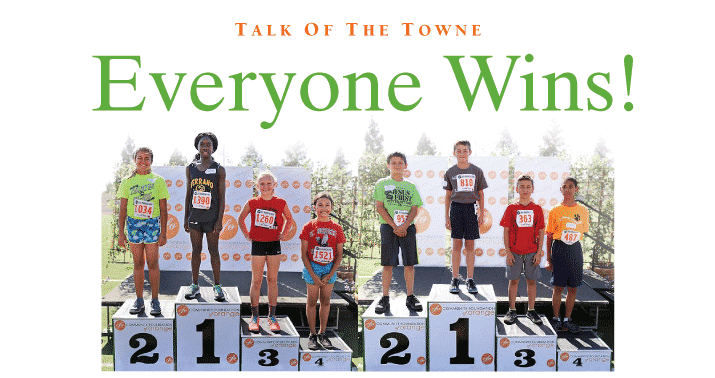
Talk of the Towne Everyone Wins

Back in 5th grade when Liliana Burns played basketball for the first time thanks to funds provided by the Community Foundation of Orange (CFO) KidsPlay™ program, during the last game of the season she made her first basket.

“Everyone stood up and clapped for her, and that really helped her self-esteem,” says Liliana’s mother, Itzi Burns. “As a matter of fact, it gave her such a boost that now in ninth grade she excels at sports.”

Successes such as this are the reason why the CFO was founded more than a decade ago by local citizens dedicated to preserving and enhancing a sense of community in Orange. Taking to heart the group’s motto to “Give Where You Live,” the organization’s 24-member board of directors, headed by current President Gary Remland, brings their diverse backgrounds and interests to the table, which has enabled the group to make a difference in several areas.

The CFO started several years ago as a fundraising entity for the building of the Sports Center at Grijalva Park, but morphed into something much bigger, says Susie Cunningham, Executive Director of the CFO. “Like the roots of a tree reaching out, taking hold and creating a strong foundation for something to grow and thrive, the CFO has responded to a variety of critical needs within the greater Orange community.”

When they viewed Orange a decade ago, the Foundation saw a need for keeping kids active and engaged, which led to the formation of the Annual Foundation Games. The free track meet for public and private elementary and middle school students in the Orange Unified School District just finished its 10th yearly event in April with 1,878 student athletes participating from 39 schools. The games were watched by 5,000 fans and 445 volunteers assisted.

Other CFO flagship programs include KidsPlay™, which enables children whose parents are unable to fund sports involvement a chance to play, and Studio Orange, which focuses on cultivating creativity and increasing arts education opportunities by providing financial assistance to students. Studio Orange events allow for the showcasing of artistic expression, such as the annual Talent Blossoms in Orange Workshop; the 4th of which was held last October and involved nearly 140 children. Open to 3rd to 6th grade singers, musicians and dancers, this year’s event involved learning Broadway melodies that the participants performed for family and friends at the end of the day.

In addition to these established, ongoing programs, the CFO recently decided to branch out further into the community to help where assistance is needed, says the organization’s president Gary Remland of Remland Insurance Services in Old Towne. “We already had a lot of support in the community, and that support is getting broader,” he says.

Now that the organization has matured, those involved have realized that the key to building a strong foundation and helping the community is to reach out to other likeminded organizations in order to band together for causes, adds Cunningham. “We’ve realized that when we work together with other groups, the results can be exponential. This has proven true with the Foundation Games.”

Recently, the CFO became involved with GRIP (Gang Reduction & Intervention Partnership.) This program, which involves the Orange Police Department, Orange County Sheriff’s Department and the Orange County District Attorney’s Office, works to prevent at-risk 10- to 12-year-old youths from joining criminal street gangs and experiencing all of the destructive behaviors that go with that life.

“Our goal is to identify at-risk youth when they are young” and not yet acting out, says Fred Lopez, daytime watch commander and public information officer for the Orange Police Department. “It’s hard to change a kid’s mind when he is 17.” Lopez said the program, which includes sports and community building efforts, works well to keep kids in school where they can make educated decisions.

Another new program in the works is a Field of Valor similar to the one held in Covina that will honor local veterans and raise funds to support them. The CFO is currently seeking partners in this effort, such as the Orange Plaza Patriots, the American Legion and the Veterans of Foreign Wars.

For more information regarding the Community Foundation of Orange, log on to Community Foundation of Orange.

Project Link
Date:
© Julie Bawden-Davis

Talk of the Towne 5 Years at the Market

When Megan Penn and other Orange residents gathered in May 2009 and hatched a plan to offer the community access to fresh food, this resulted in the Orange Home Grown Farmers & Artisans Market that opened two years later.

In addition to their goal of providing residents with locally grown and produced healthy foods, the founders of the farmer’s market also made it their mission to “cultivate community and inspire change through activities that foster education, awareness, advocacy and create benefits for the greater good,” says Penn, Executive Director of Orange Homegrown.

Today Orange Home Grown supports a variety of initiatives that fulfill their mission, including the all new seed lending library, which opened recently and gave away 350 seed packets in its first two weeks, an annual chicken coop tour, an upcoming education farm and scholarships.

Chicken Coop Tour

This event starts at the farmer’s market with a talk on raising chickens, followed by a self-guided tour to chicken coops in Orange.

Kristine Rohm is Director of Immanuel Lutheran Preschool and Kindergarten and began raising chickens at the school after taking the first tour in 2013. “My teacher and I were so inspired when we saw other coops that we felt confident we could raise chickens and they would benefit the students,” she says. “Being able to talk one-on-one with real chicken owners was the key to our success. Two years later, we were on the tour.”

Rohm enjoys having chickens at the school, because they teach young children about the natural world. “We have four chickens—Aurora, Buttercup, Cuddles and Dot,” she says. “The children can go into the chicken run daily to check for eggs, feed them or even pick one up if they can. Friday is Free Range Friday; the chickens get to roam freely in our play space, which is a treat for our preschoolers and the chickens.”

Rohm reports that she’s continually impressed by the work being done by Orange Home Grown. “The Farmers & Artisans Market is not just a top notch market—it also provides a wealth of education and resources for children and adults with talks, children’s programs and special events. The passion found at the market for local and healthy food brings awareness to our community of what used to be a normal way of life.”

Scholarships

To further their mission of spreading the word about sustainable living, Orange Home Grown also sponsors scholarships for aspiring college students planning on getting degrees in areas that focus on agriculture or helping the earth.

Anayeli Sarabia is a student and scholarship recipient, who also works at the farmers market selling produce from her aunt’s farm. “Being a recipient of the Orange Home Grown Scholarship was a great help with paying for my classes and buying books,” she says. “I am so grateful that there are people like the Orange Home Grown founders who think about others. When I received the scholarship, I was attending Riverside Community College. In the fall, I’ll be starting at Cal Poly Pomona for Agri-business and Food Industries Management.”

Dean Kim is owner and executive baker for OC Baking Company and an Orange resident. He is a vendor at the farmers market and comments on Orange Home Grown’s outreach. “Orange Home Grown is all about advancing Orange,” he says. “It’s a privilege to be affiliated with the organization.”

• The Orange Home Grown Chicken Coop Tour is Saturday June 25th from noon to 3 pm.

Orange Farmers and Artisans Market
304 North Cypress Street, Orange CA 92866 / 714-397-4699

Project Link
Date:
© Julie Bawden-Davis

M & M Nursery

In 1956, when the heady scent of orange blossoms filled the air in Orange, M & M Nursery opened in the middle of a grove next to a small, two-lane street named Tustin. “The times were so trusting back then, there wasn’t even a fence around the nursery,” says Dale Garey, who today co-manages the nursery with her brother Ted Mayeda.

Opened by Dale and Ted’s mother, father, aunt and uncle, M & M was a play and learning ground for the brother and sister, who as children absorbed a love of plants and an understanding of the nursery trade.

“There was a housing boom in the 1950s, so my parents and aunt and uncle sold an abundance of landscape foundation items like trees and shrubs,” says Garey. “Through the years, the nursery has seen a wide variety of trends. We were here when macramé hangers and terrariums were the rage in the 1970s, and now both are in again.”

Unlike many Orange County independent nurseries that disappeared over the years, M & M has stood the test of time. Thanks to the foresight of Ted and Dale and their Head Designer Beverly Turner, the nursery has responded to the gardening market’s shift from functional planting to gardening as a hobby. As a result, they’ve become well known for a variety of niche gardening specialties, including rare cottage garden plants, water features, garden art and fairy gardening.

The nursery’s fairy garden expert is Turner, who Orange County Register garden columnist Cindy McNatt calls the Fairy Godmother of Fairy Gardening. “Beverly deserves credit for starting the whole trend,” says McNatt. “Thirteen years ago, way before anyone even thought of fairy gardens, she created her first while decorating the outdoors of a dollhouse.”

Turner is on hand at the nursery most days ready to help fledgling and more experienced fairy gardeners with the hobby. “Some people require a lot of direction at first, but they eventually get the hang of it,” says Turner, co-author of the bestseller Fairy Gardening: Creating Your Own Magical Miniature Garden. “I’m always delighted to see the birth of another creative gardener.”

M & M is a one-stop fairy gardening resource. The nursery carries just about any accessory you can think of, from high-quality fairies, to tiny furniture, miniature arbors and trellises and cute little animal figurines. They have a raised bed demonstration garden, as well as many containerized fairy gardens for sale.

They also carry a wide assortment of truly miniature plants for use in fairy and railroad gardens, including a proprietary selection of 20 sought-after dwarf trees that can only be found at the nursery. “A small tree creates such a great focal point for any miniature landscape,” says Mayeda, whose collection includes dwarf Serissa, which features a delicate white or pink flower, as well as Cuphea, which also has minute flowers in white, lavender or purple. Another example of how this truly unique nursery has elevated gardening to an art form.

M & M Nursery
380 North Tustin St, Orange, CA 92867 | 714-538-8042

Project Link
Date:
© Julie Bawden-Davis

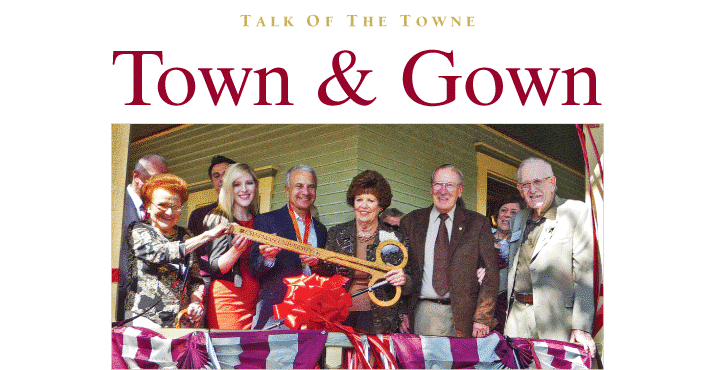
Talk of the Towne TOWN & GOWN

Curious about what goes on at Chapman University and interested in helping worthy students achieve an education? Check out the nonprofit organization Town & Gown. Serving as a link between the university (gown) and the community (town), the group holds a variety of events throughout the year designed to give members a taste of what Chapman has to offer while raising funds for student scholarships and campus enrichment projects.

“Town & Gown is comprised of interested community members who enjoy learning about the university, meeting faculty and attending academic, social and cultural functions,” says the organization’s current president Marcia Cooley. “Our most popular activity is our Lunch at the Forum series, which includes an excellent lunch and fascinating lectures.”

Held five times a year, Lunch at the Forum events feature presentations by an assortment of faculty members and are catered by Sodexo, the school’s food service provider. The next lunch on February 2nd is titled “The Arab Spring: Implications for U.S. Policy.” Speaking are Dr. James J. Coyle, Director of Global Education and Dr. Nubar Hovsepian, Associate Professor of Political Science and International Studies. Both are Middle East experts, but a panel discussion format may show divergent views. In March, they will feature “The Impact of Design: From the Olympics to Medicine.” Professors Eric Chimenti and Claudine Jaenichen will discuss how design affects our lives and are bringing students to demonstrate their work. Past events this season included the presentation, “How Congress Really Works: The Budget and Debt Ceiling,” presented by the Dean of Chapman University Law School Dr. Tom Campbell and “Beyond the Notes” by renowned pianist and Director of Keyboard Studies, Dr. Grace Fong.

The Town & Gown organization awards need and merit–based scholarships, and recipients are introduced at the luncheons, notes 1948 Chapman alumnus Mary Lou Savage. “Seeing the kids who have benefited from the scholarships and being on the active campus is an exciting, uplifting experience,” she says.

Savage started the Lunch at the Forum program in 1994 when she was president of the organization. “At the time 18 years ago, Town & Gown, which was founded in 1968, kept members busy with off–campus activities such as bus tour trips, but few events were actually held at the college,” she says. “Though the field trips were fun and we still do them, I didn’t think we were fulfilling our mission statement, which is to be a liaison between the school and community. I told President Doti of that concern when I approached him about starting the luncheons. He agreed to the events and let us host them at the Argyros Forum, which had opened two years before. The luncheons were an immediate hit.”

People enjoy the Lunch at the Forum events because they are a fun opportunity to learn, adds Melida Canfield, Co Vice–President of Programs and a board member. “I discover interesting information listening to the professors’ lectures, and I really like making new friends over lunch.”

In addition to awarding scholarships to worthy Chapman students each year, Town & Gown has underwritten a number of on–campus projects such as the gardens at the Elliott Alumni House, a reading alcove at Leatherby Libraries, an endowed library fund for the arts, humanities and social sciences to purchase books for the library and the Gentle Spring fountain in Escalette Plaza.

Members’ dues and gifts support these projects, but anyone who wishes to can attend the Lunch at the Forum events.

For information on tickets to Lunch at the Forum, which can be purchased as a series for $125 or individually for $30, contact Melida Canfield at (714) 745-7851 or email her at MelidaC@SevenGables.com. For information regarding membership, call Judy Crum at (714) 532-3264.

Published in the Jan/Feb 2012 edition of the Old Towne Orange Plaza Review

Written by Julie Bawden-Davis, Photograph by Marcia Cooley

Project Link
Date:
© Julie Bawden-Davis

Phyllis and Ross Escalette Permanent A Major Art Collection in Our Neigborhood

To view a major collection of art you usually have to buy admission to a museum, but Old Towne residents need only visit Chapman University. There on campus is the Phyllis and Ross Escalette Permanent Collection of Art consisting of more than 700 pieces of contemporary works.

“The collection, which features many Southern California artists, is unique in that you come across it as you make your way through campus,” says Chapman’s collection manager David Michael Lee. “It’s an organic approach to displaying art that makes it accessible.”

Chapman’s curator Maggi Owens started the collection in 2000. “At the time, I had a modest budget, so I sought donations,” she says. “Artists were happy to donate and be part of the collection, and we obtained some wonderful pieces as a result.” (Since 2009, a $2 million endowment donated by Phyllis and Ross Escalette of Newport Beach has supported the collection.)

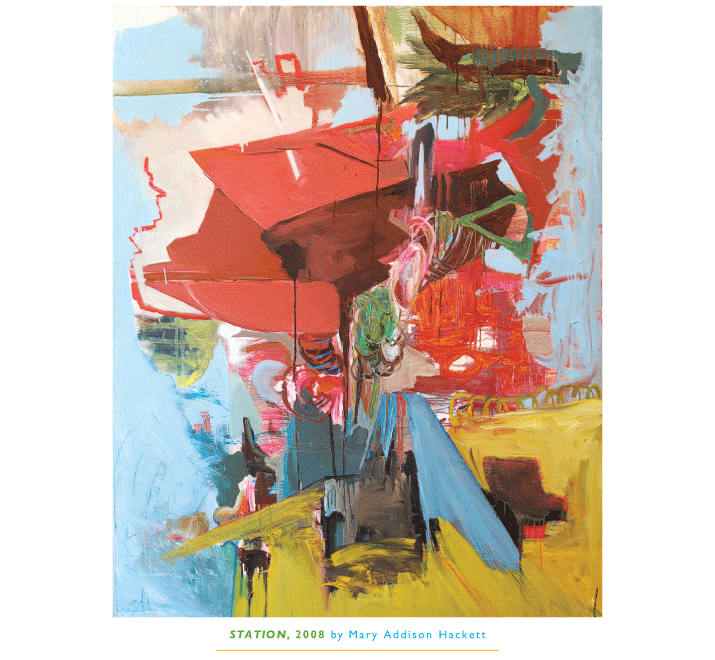
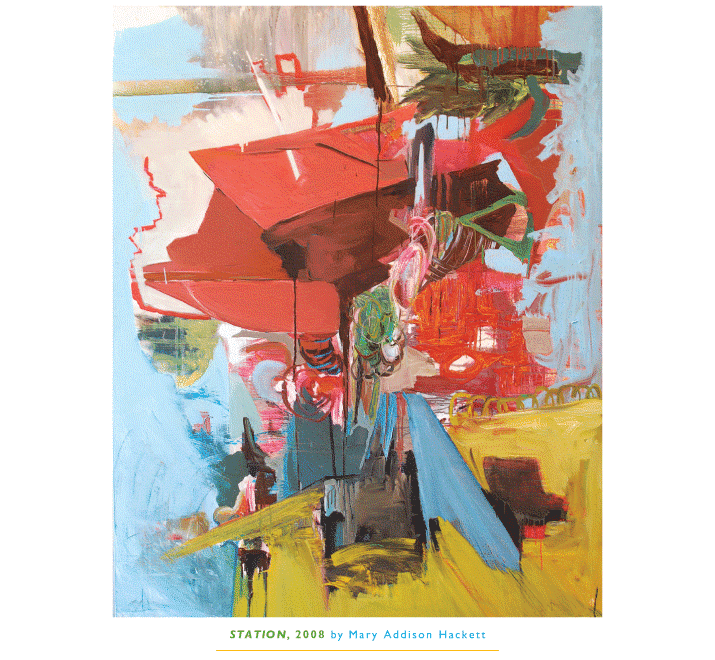
One especially striking painting Owens procured via donation is “Station,” by Mary Addison Hackett, who resided in Los Angeles when she painted the piece and currently has a studio in Nashville. The colorful abstract is an oil on canvas that measures 60 x 48 inches and hangs in Beckman Hall, where a large concentration of the collection is located.

“When I visited Hackett’s studio, that piece hit me immediately,” says Owens. “The colors blend so well, and there are a lot of angles to the piece, which gives it depth. I also like the movement. She’s a very good artist, and her work adds value to the collection.”

Lee agrees that the piece makes a powerful addition. “The painting features an explosion of color, and it’s a great example of abstraction,” he says.

Phyllis and Ross Escalette Permanent Collection of Art

Hackett decided to donate “Station” when she saw that Chapman had collected works by artists whom she respects. “I wanted the painting to be cared for within a collection where it would be seen and hopefully inspire others,” she says. “The diversity and breadth of Chapman’s collection is an amazing resource for encouraging dialogue and gives students the opportunity to see art as a respected staple of daily life.”

Hackett painted “Station” in 2008 while concentrating on large scale pieces. “At the time, I was interested in ideas surrounding landscape, architecture and technology,” she says. “The painting is not inspired by a particular event, but if it were, it might be something slightly futuristic. I remember the blue needed to convey an enveloping thickness. The title could reference a space station, a resting point between two places, or any other connotation of the word station.”

Hackett’s work has shown in numerous California venues, as well as nationally and internationally. She’s exhibited at Torrance Art Museum, Kristi Engle Gallery in Los Angeles and Irvine Fine Arts Center. According to the artist, her work is prompted by her experiences, actual or embellished events and memories from her life.

“My first influence was my family. They gave me books and subscriptions to art magazines like ARTnews and Art in America when I was still in single digits,” she says. “When I started painting, the Neo-expressionists were a major influence, but then I spent the 1990s in Chicago where there was a dearth of painting and an abundance of theory. I moved to LA in 2000, and suddenly I was in an oasis of painting.” A sampling of that oasis can now be seen at Chapman.

Project Link
Date:
© Julie Bawden-Davis

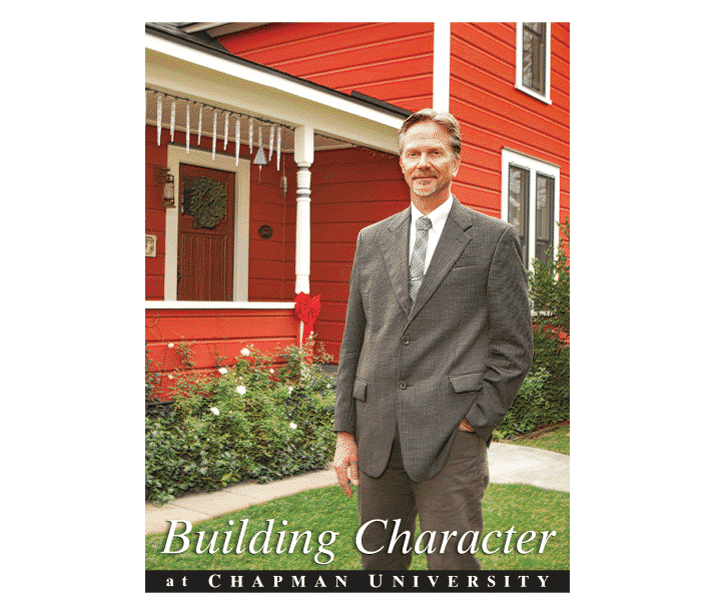
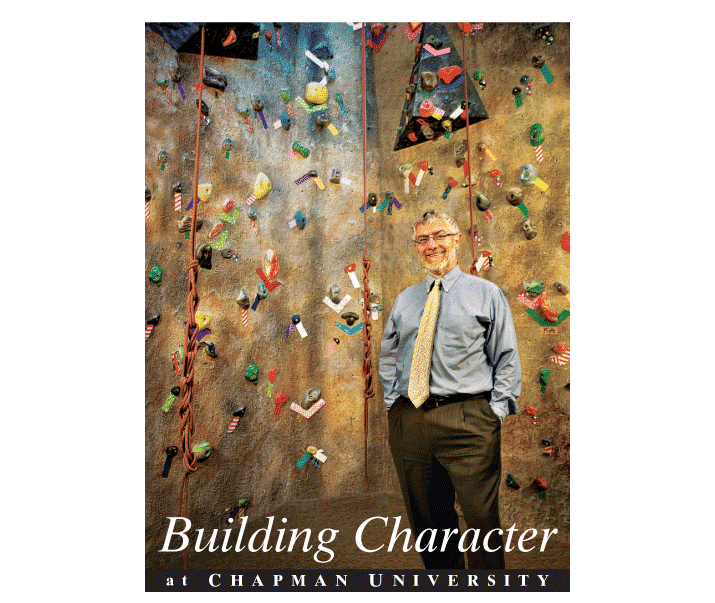
Building Character Kris Eric Olsen

Kris Eric Olsen

When Kris Olsen traveled to Norway in 2006 to trace his roots, Chapman University’s Vice President of Campus Planning & Operations discovered a surprising parallel. As he walked the streets of Kristiansand with his Norwegian cousin, his relative pointed out prominent buildings and residences constructed in the mid-1800s, informing him that his great-great grandfather Osmund Olsen had been the master builder. “Finding out that my great-great grandfather held the equivalent of my job as a modern day planner and builder was an extraordinary experience,” says Olsen, who directs the building and renovation of Chapman University properties. “It was a nice surprise to find that I had planning in my blood. As a kid, I often played with Legos, and in high school I took elective mechanical drawing and drafting classes, always wondering where I got the interest.” Fast forward to today and take a look around the Chapman campus and you quickly see Olsen’s mark. Since he joined the university in 2001, he has orchestrated more than 100 building and renovation projects, including the restoration of various historic structures and the construction of many new buildings, such as the $20.5 million Lastinger Athletic Complex, the 4-story Leatherby Libraries and the film school’s $42 million, 76,000-square-foot, state-of-the-art Marion Knott Studios. Recently he managed an expansion of Argyros Forum and is in the planning stages for several large projects breaking ground within the next 14 months, including a Filmmakers’ Village and a 1,100 seat Center for the Arts. For Olsen, possessing the skills to take on such an array of challenging building projects comes from a varied career that started with working for Disney in the late 1970s and early 1980s. “I was a draftsman and then designer for Epcot’s Imagination Pavilion and Spaceship Earth,” he says. Though he enjoyed the project, which was Walt Disney’s final brainchild, Olsen grew weary of working at a drafting table all day in a building with no windows. “I thought there has to be something more,” he recalls. “I took note that about once a week the project manager would come in to check on things. He’d have a suntan and have just come back from meeting with the city or from the construction site. I thought-that’s the job I want.” After the Epcot project, Olsen took a year off to “live dangerously,” trying various experiences as they arose. He worked for ABC Sports as an assistant photographer for the 1984 Summer Olympics, lived in Hawaii and was a ski instructor in Big Bear. “That year allowed me to try various experiences so I wouldn’t have any what-ifs later-at the same time solidifying the fact that I wanted to be in building development,” he says. After his year of exploration, Olsen became project manager for the nonprofit World Vision at their Pasadena campus where he worked until the late 1980s. He met his wife Lori there, and they married in 1987. By the early 1990s, Olsen had a young family and found project management work in the hotel industry more lucrative. For 12 years, he developed everything from roadside motels to 5-star hotels. The work was satisfying but required a great deal of travel, so he interviewed for Chapman’s planning and construction management position in 2001. “I was intrigued by the idea of staying in one place and working on the historic renovation of old buildings and new projects designed to last 100 years,” says Olsen, who landed the position. Gary Brahm is Chancellor for Chapman’s Brandman University and was executive vice president and chief operating officer in 2001 when he hired Olsen. “Kris is an extraordinary guy with honesty and integrity and obviously an incredible project manager able to juggle a tremendous amount of complex projects at varying stages,” says Brahm. “He has an artistic ability and sensibility to Old Towne standards.” Local architect Susan Secoy of Secoy Architects Inc. is based in Old Towne at the Icehouse and comments on Olsen’s work. “I respect Kris’s professionalism and his concern with design details. He is well-informed about historic preservation and has done a very good job on restoration work such as the Western Cordage Building,” she says, referring to the historic adaptive re-use of the 1923 building now called Crean Hall located at 501 West Palm. When it comes to new construction and preservation work, Olsen also keeps lines of communication open with the community, says Old Towne resident Bob Hitchcock, former president of the Old Towne Preservation Association (OTPA). “Kris made Chapman a good neighbor by taking our concerns seriously. When we had issues with the height of the university’s upcoming performing arts center, he worked with the architects for a solution, which involves building underground.” One of the best parts of Olsen’s job is the historic restorations. “I really enjoy restoring historical buildings to their original conditions as closely as feasible,” he says. “It’s extremely satisfying to give them a new lease on life so perhaps they may live another 100+ years.” No doubt Great-Great Grandpa Olsen would be pleased.

Chapman Residential Restorations

In addition to constructing new buildings, Chapman has restored over a dozen historic homes on the perimeter of the school, including a 1905 Folk Victorian Farmhouse. Originally owned by Milo and Rosa Stutsman, the house was restored in 2010 and now serves as home to Chapman University’s Vice President of Campus Planning & Operations Kris Olsen and his wife, Lori. “Like many of the homes Chapman has restored, the house was in pretty rough shape, but the structure had good bones and plenty of original features with which to work,” says Olsen. “The house came out great, and it’s an honor to live in such a fabulous historic structure.” Other notable Chapman-restored residential properties include eleven bungalows and cottages on North Center and North Lemon streets. The latest project is a 1925 Craftsman at 238 West Palm that had been turned into a concrete business office and is being returned to its residential roots.

Published in the Jan/Feb 2012 edition of the Old Towne Orange Plaza Review

Written by Julie Bawden-Davis, Photograph by Scott Montgomery

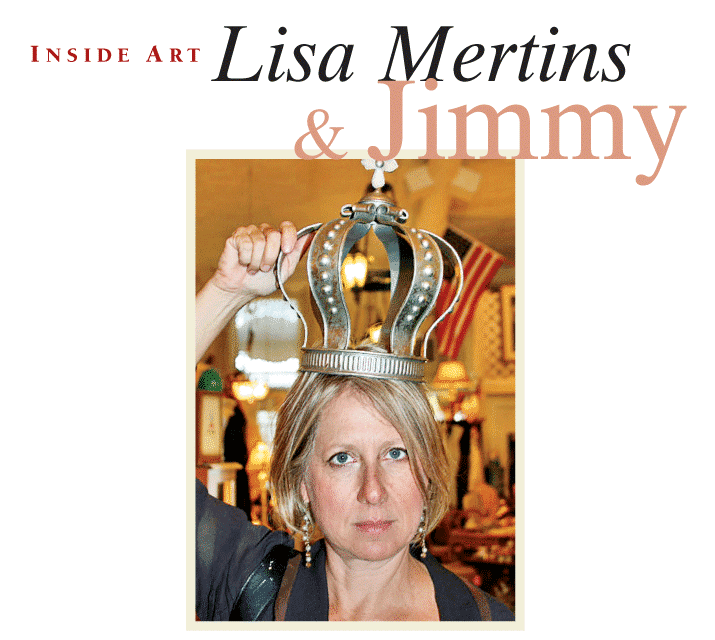
Inside Art Lisa Martins & Jimmy

At first glance, art seems solely visual, but accomplished artists like Lisa Mertins know intrinsically that art goes much deeper than what you actually see. While effective art attracts the eyes, it is the thoughts and feelings art evokes that makes it memorable.
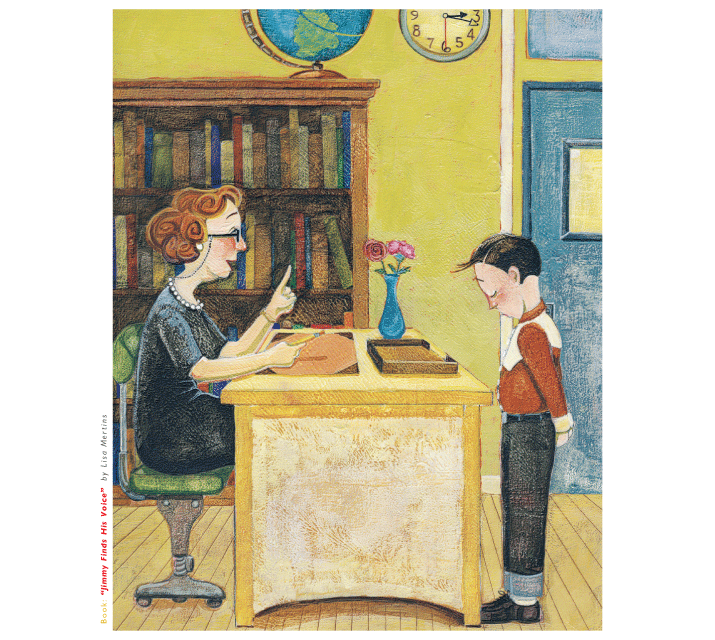
An accomplished illustrator and multi-media fine artist, Mertins produces work that tugs at the heart. Whether it is an illustration of a mom kicking up her heels and enjoying her child for an article about parenting, a fine art ceramic piece featuring a seemingly carefree bee pollinating flowers or a children’s book illustration of a shy little boy, the viewer can’t help but react. “My strength lies in conveying emotions or feelings thanks to my experience with conceptual illustrations,” says Mertins of her nearly 30 years at The Orange County Register illustrating hundreds of newspaper articles. Her work on the recently released children’s book, Jimmy Finds his Voice, proves this statement to be true. Written by Chapman University’s president James Doti and based on his childhood experiences, the book chronicles the story of Jimmy, a first grader with a speech impediment, who is petrified when his teacher asks him to be in a class play. “Lisa is an especially sensitive person,” says Doti. “She made sure that the illustrations closely mirrored my memories and reflections, and they help tell the story, which is important for a picture book. Young readers are astute and notice details, such as Jimmy’s red cheeks when the other children are laughing at him and the teacher wagging her finger at him in the illustration pictured in this issue.”
Lisa Mertins

Book Signing and Release Party on Thursday, March 14, 2013 at 6 – 9 pm at Chemers Gallery, 17300 17th St, Suite G, Tustin CA 92780

Kirkus Reviews agreed with Doti’s assessment of her work when they said, “The illustrations by Mertins are wholly appealing. Their soft, watercolor tones capture both Jimmy’s fears and his eventual triumph.” The artist has illustrated six children’s books, including her first, Gingko and Moon, which she wrote and illustrated back in 1996. She was inspired to create the book when she drove past gingko trees everyday on her way to work and saw the leaves turn bright yellow in fall. Mertins, who liked art as a child, grew up in Santa Ana. She got a job out of high school at a bank, but soon found the work didn’t suit her. In 1979, she answered a fateful ad seeking an artist “with no experience necessary” at The Orange County Register. The position was in the circulation department and involved her creating fliers for paper carrier incentives. In 1985, she transferred to the art department of the newsroom, where she stayed until 2009, except for a brief period when she moved out of state. “I was very fortunate to have the job at The Register,” says Mertins. “There was never a dull moment, and I loved going to work.” She particularly enjoyed the variability of the job. “It’s hard for me to keep interest in something for a long time, so I liked having a new assignment every week,” she says. She also enjoyed the opportunity to try a wide variety of art mediums, which is something that has benefited her current career as a fine artist. “Especially in the early days, we had the latitude to use any kind of medium that we wanted, so I did everything from painting to paper mache,” she says. “For one assignment, I even carved into limestone.” Towards the end of her career at the paper, she completed many computer generated illustrations. Today Mertins, who is married and has two grown children and a teenager, lives in Cherry Valley. She spends her time doing freelance commercial assignments and creating fine art. With the fine art, she’s had a chance to dig deeper. “Many people have described my work as whimsical, but I’m trying to break away from that,” says Mertins, who does painting ceramics and printmaking. “I want to express the difficult and trying experiences that people endure, and I hope to reveal my authentic self through my work. I don’t yet know exactly what I want to say. I suspect that will be the rest of my life pursuit.” – See Lisa’s work on her website at LisaMertins.com – Find Jimmy Finds His Voice at book resellers, such as Amazon.com

Published in the Jan/Feb 2013 edition of the Old Towne Orange Plaza Review

Written by Julie Bawden-Davis, Photograph and Artwork provided by Lisa Mertins

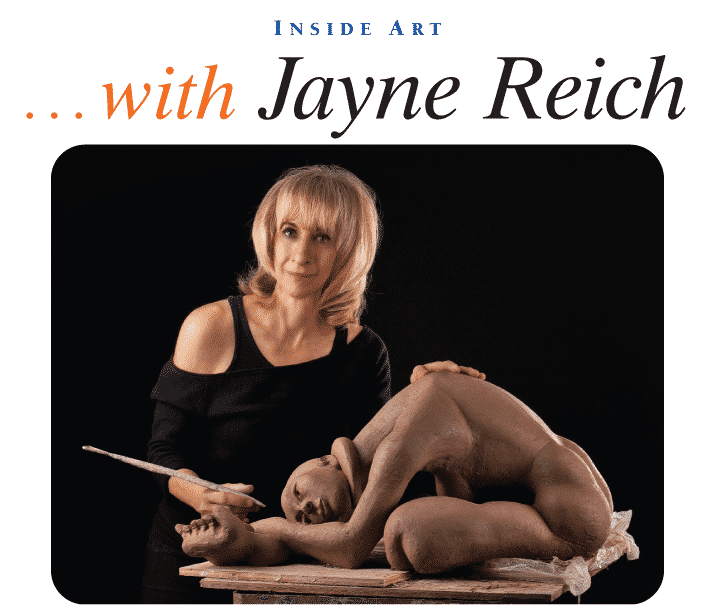
Inside Art With Jayne Reich

View the work of artist/sculptor Jayne Reich, and while you’ll enjoy the form and figure of each piece, it’s the understanding on a soul level forged between the artist and her model that holds the message. Reich’s art, which doesn’t require and even rejects explanation, represents a melding of human consciousness and unconsciousness that she identifies as a source of living reality.
“The human figure is my passion and inspiration,” says the artist, whose art is widely collected by prominent inpiduals, as well as on display at Chapman University. She works from live models, creating three-dimensional, 360-degree sculptures of the human form. Her extraordinary pieces, with names such as “Limitless,” “Transformation,” “Contemplation” and “Exultation,” invite the observer to experience her art at a primal, gut level. “The creative process, which is collaborative for me, is deeply intuitive. I begin a piece without knowing where I’m going in order to discover my own inimitable truths,” says Reich, who paints and sculpts and has taught figure drawing, a complete art form in itself, at The Art Students League of New York and the Pennsylvania Academy of Fine Arts. “I’ve developed a natural style that is an expression of self and as authentic as my signature.” Intuition at the Heart of Art It is the nature of intuition and its role in the process of creation that Reich discusses with her longtime mentor, well-known Quantum Physicist Yakir Aharonov, who is a fan of her work. He bought her sculpture “Transcendence,” and honored her by requesting it be placed in the alcove dedicated to him at Chapman’s Leatherby Libraries, along with other priceless items, including his National Medal of Science in Quantum Physics and his Letters of Einstein and Bohm. “Intuition is at the core of many discoveries by great physicists,” says Reich, who is married to physicist Jeff Tollaksen, Director of the Institute for Quantum Studies at Chapman University. “When Yakir and I discuss the creative process, what comes up repeatedly is how to develop deep and true levels of intuition in order to make new discoveries. For instance, without formal training, Indian mathematician Srinivasa Ramanujan, whose life was depicted in the movie, The Man Who Knew Infinity, received while praying flashes of the most complex and amazing mathematical formulas that he wrote on the temple floor.” For Reich, discovering Aharonov proved synchronistic when she met him in the late 1980s. Her mentor of many years, artist Marshall Glasier, had passed away, and she sought someone beyond the traditional art mentor. “I had tried studying with many teachers, but, with the exception of Marshall, I found they wished to emphasize technique. Creativity isn’t a technical skill. Art is about your soul—it transcends the mundane and takes on a metaphysical aspect. As Einstein said, ‘Imagination is more important than knowledge. For knowledge is limited to all we now know and understand, while imagination embraces the entire world, and all there ever will be to know and understand.’ ”
 
The Keys to Creativity Reich became a student of Aharonov’s when her husband began working with him as a graduate student. “Rather than study physics with Yakir, I looked at the creative process in terms of the geniuses of the world and their use of an incredibly deep level of intuition,” she says. “While doing so, I accessed my true voice and authentic process, and that enabled me to sustain integrity in my work.” Prior to Aharonov, for 25 years Reich was the assistant and protégé of Glasier, who was trained by renowned German expressionistic painter, George Grosz. “I took my first class with Marshall in New York when I was 19. On the first day, as I sat on a stool with a drawing pad trying to draw a model, he came in and made a beeline across the room. He was a big, clumsy guy and accidentally, on purpose, knocked the stool from underneath me and said, ‘You’ve got to stand up for what you believe in!’ I thought, this is my teacher. He’s talking my language.” Reich grew up in New Haven, Connecticut, the daughter of parents involved in musical theater. For a time, her father owned a toy company, but it went bankrupt when he died of an aneurism when she was five. For several years, she lived in a segregated housing project surrounded by streams, forests and caves, where she enjoyed spending time. From a young age, Reich felt an affinity with her great grand-uncle, well-known New York philanthropist Harry Fischel, who helped thousands of Jewish immigrants escape to the U.S. during the war. In another synchronistic turn of events indicative of Reich’s life connected to scientists and physicists, Fischel also happened to be the founder of Yeshiva University in New York and Jerusalem, where her future mentor, Aharonov, taught and founded their physics department. Even more, Reich’s great-uncle, the prominent Rabbi Herbert S. Goldstein, defended Einstein when he was accused of being an atheist communist. Goldstein had an article published in the New York Times that publicly proclaimed Einstein to be a pantheist, who believed in God and was therefore not a communist. In addition to influencing her artistic expression, Reich’s storied ancestry and experience living in the segregated housing project gave her a keen interest in human rights. “I’ve always been inspired by people who stand up for what they believe in,” says Reich, who has worked as a life coach, including for celebrities, and lived for many years with Ruth Ellington, sister of Duke Ellington. “During high school, I ran away from home for a couple of days to attend Martin Luther King’s March on Washington when he made his ‘I Have a Dream’ speech. I ended up holding his and Coretta King’s hands. It was the most incredible moment. I’d never met a man who radiated so much love. That experience changed my life and affected my art.” Perimeter Institute Conference Last summer, Reich accompanied her husband to the Perimeter Institute Conference of Quantum Physicists in Montreal for a month-long program based on the work of Aharonov. “I fell in love with the sophisticated, sleek design of the institute’s building, including the light and stunning views, and the many chalkboards for expressing creativity,” says Reich, who devised a project during the conference that intersected art and science. In an impromptu studio, Reich drew 44 collaborative portraits of the physicists and others at the institute. Drawing with chalk on black paper that mimicked chalkboards, she talked with her subjects as she worked. When she finished, they added to the co-creations by including important equations or signatures. Physicist Lucian Hardy, world renowned for his discovery of “The Hardy Paradox,” was one of Reich’s subjects and commented on the experience. “Art is a powerful way of representing and thinking about reality. Then the artist and subject are part of the process. Each influences the other. Sitting for Jayne was like being part of a quantum experiment, but on the unfamiliar side of the Heisenberg cut.” Reich follows the same co-creation process when she sculpts. “I always give the model credit, because it truly is a collaborative effort. I let my intuitive energy merge with the model’s so that I bring forth the person’s essence. Most importantly, I want the work to come alive so that I end up with a source of living reality that creates a living eternity.” Charlene Baldwin, Dean of Chapman University’s Leatherby Libraries, believes Reich’s work accomplishes that goal. “Jayne’s art is transformative, like her piece ‘Compassion,’ featured in this issue and on permanent display in the Aharonov Alcove. The sculpture personifies the intersection of art, science and creativity, displaying beauty of movement and form. Her living art holds energy and spontaneity and captures the classical figure, while at the same time transcending it.”

Published in the Jan/Feb 2017 edition of the Old Towne Orange Plaza Review

Written by Julie Bawden-Davis, Photographs provided courtesy of Chapman University

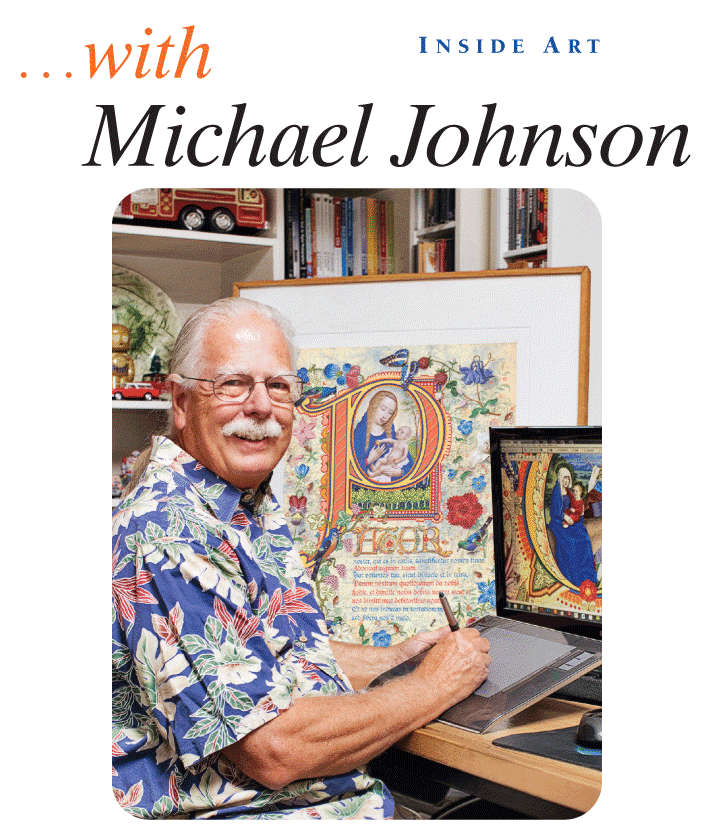
Inside Art With Michael Johnson

While it’s not uncommon to save Christmas cards received every year, it’s rather unusual to frame them. Yet that’s what recipients of Michael Johnson’s works of art do. What began as a graphic design project in 1991 for a former employer resulted in Johnson creating digitally produced Christmas cards that morphed into a growing body of religious themed art that can be enjoyed throughout the year. Often depicting Madonna and Child and featuring prayers, songs and Bible verses that Johnson translates into Latin, his art is available in various sizes, from 5.5 x 7 cards to 7.5 x 9.25 framed pieces to 32 x 21 posters. For 24 years, the retired Professor of Fine Arts sent out limited edition pieces to friends and family during the holidays. Now that he’s Professor Emeritus in the Media Arts Design Department of Cypress College, he creates his pieces fulltime in his Old Towne home studio, where he’s lived since 1975. “Back in 1991, I worked for the computer software imaging company ULead Systems, which had the first true color image editing software, PhotoStyler, sold through Aldus software, which eventually merged into Adobe,” says Johnson. “I modified a book cover I did for them to create Christmas cards, and that started a yearly tradition.” Spiritual Inspiration Raised Catholic and a longtime member of Holy Family Cathedral in Orange, Johnson often receives inspiration for his work while in church. “As I listen to gospel readings and homilies, they stick with me until the thoughts result in art,” he says. Johnson also gets ideas by studying various forms of art, including paintings created during the Renaissance and Gothic periods, as well as illuminated manuscripts. As part of his own creation process, he incorporates various symbols into his artwork, like flowers, butterflies, ants, ladybugs, fruit and most recently birds. “I kept noticing birds in many pieces of art and how they symbolized the winged soul and the angels, so I decided to incorporate them,” says Johnson. “Such imagery can be quite rich in its meaning. For instance, a strawberry with its white and red color is a symbol of purity and martyrdom.” Monsignor Arthur Holquin, Pastor Emeritus of Mission Basilica San Juan Capistrano, met Johnson and his wife, Frances, in 1974 after he was ordained and assigned to Holy Family parish in Orange. He enjoys receiving Johnson’s art pieces every year, especially since he has an interest in art and in medieval illuminated manuscripts. “Michael’s utilization of digital technology in not only replicating this art form for today, but also adding his own creative artistic twist, is fascinating,” says Holquin. “Like all artists, Michael is keenly aware that ‘the beautiful’ reflects the transcendent. I have often said that art in general, and religious art in particular, is visual theology. As a man of faith, Michael understands this role of art, and that understanding is reflected in the beautiful images he creates combining text and visuals. A purist, who has a profound respect for artistic history, Michael includes Latin text as an element of continuity with medieval manuscripts that almost always used the Latin language.” Ed Giardina, a Professor of Art at Cypress College, has known Johnson for 12 years and considers him a mentor. “I admire how Michael appropriates historical religious imagery, and I especially enjoy his attention to the details,” he says. “He passionately renders everyday nature into unusual sociological ecosystems. I have always assumed many of these coded symbols are representative of things or people in Michael’s life, including the little chirping birds and bugs zooming around.” “The Lord’s Prayer” The artwork shown here is titled, “The Lord’s Prayer,” and depicts the Madonna and Child. The text is the iconic prayer in Latin. “The Child is holding onto the apples, as if religion could be a fruit that you can hold onto,” says Johnson of the piece, which is part of a triptych of popular prayers that can be hung together or as standalones. “The tree in the background represents the wood of the crucifixion and the tree of growth.” Johnson enjoys the digital painting process, because of its forgiving nature. “Once you’ve made a mark on a piece of paper, it stays, but digital art allows for safe exploration and the ability to make changes,” he says of the software that imitates traditional drawing and painting tools. This is not to say that the process isn’t extensive. Johnson starts by making a rough composition of each piece and then works on the many individual elements, eventually combining them all. “I’ll paint a flower slightly larger than I need it and then scale it down when I combine it into the piece,” he says. As he works on each element, he saves the various files so he doesn’t lose any work. “Some of the components have hundreds of files,” he says. “In a flower alone, there may be 25 to 30 layers in each petal that I will save and then periodically merge together and continue painting.” Artistic Beginnings For Johnson, who grew up in Santa Ana, art always came easy. He recalls winning a poster contest for the city of Santa Ana while in junior high. He attended Santa Ana College and California State University, Fullerton, where he received his Bachelors of Art and Masters in Drawing and Painting in 1975. He initially thought he wanted to work at an ad agency, but tried and enjoyed teaching. After instructing at various area colleges, he landed a fulltime position in 1983 teaching advertising design, drawing and painting at Cypress College. In 1985, he began teaching in the burgeoning field of computer art, which he continued to do throughout his career. The role required that he constantly learn about new technological developments, which he enjoyed sharing with students. Orange resident Dan Stephens, the longtime art tech for Cypress College’s Fine Arts Department, comments on Johnson’s commitment to students. “Michael was very dedicated to his students and the computer graphics program,” says Stephens. “He constantly looked for ways to bring technology into the arts program.” Stephens has collected all of Johnson’s Christmas card pieces. “I hang them every holiday season,” he says. “They take up an entire wall and look very impressive as a group. Michael has an eye for detail that shows in his work. He sees the world through a camera lens, zooming into a section of a large scenario and creating a micro-environment that would otherwise go unnoticed.” For more information on Michael’s limited edition signed prints, please go to www.capiolumenimages.com.

Published in the Nov/Dec 2016 edition of the Old Towne Orange Plaza Review

Written by Julie Bawden-Davis, Photograph by Michelle James

Inside Art With the Hilbert Collection

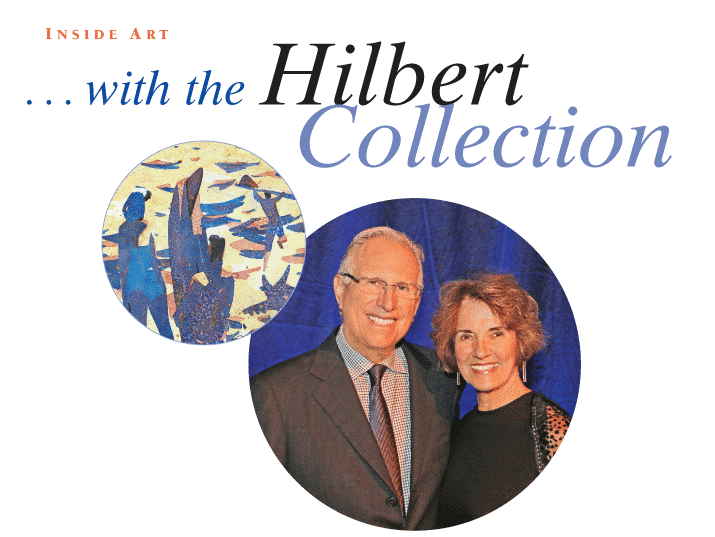
When Mark and Janet Hilbert bought their first home in 1993, the couple’s tight decorating budget prompted them to scour garage sales and consignment shops for reasonably priced furnishings and accessories. Delighted to find a watercolor painting they liked in an antique store, the Hilbert’s brought the piece home and hung it.

Discovering the Allure of California Scene Painting

“After looking at the painting for a period of time, we found that we really loved the watercolor medium because it has a certain spontaneity and realism,” says Mark Hilbert. “We went back to buy another painting in the same style, also discovering the book, California Style, by Orange native Gordon McClelland. The book covers the art genre known as California Scene painting.” Largely unknown in the 90s and even now, the California Scene painting movement spanning the 1930s-1970s, depicts ordinary people going about their lives doing ordinary things. Illustrating California’s historical and social history, the paintings feature the work of iconic Golden State artists like Millard Sheets, Emil Kosa Jr., Phil Dike and Rex Brandt. Some of the pieces are in oil, but most are watercolors with broad, wet strokes illustrating the dramatic and expressive style of the genre. Fascinated by the California Scene art period, the Hilberts continued acquiring paintings, eventually creating what is known as the Hilbert Collection, which currently contains approximately 500 oils, watercolors and drawings and more than 500 lithographs.

Substantial Collection

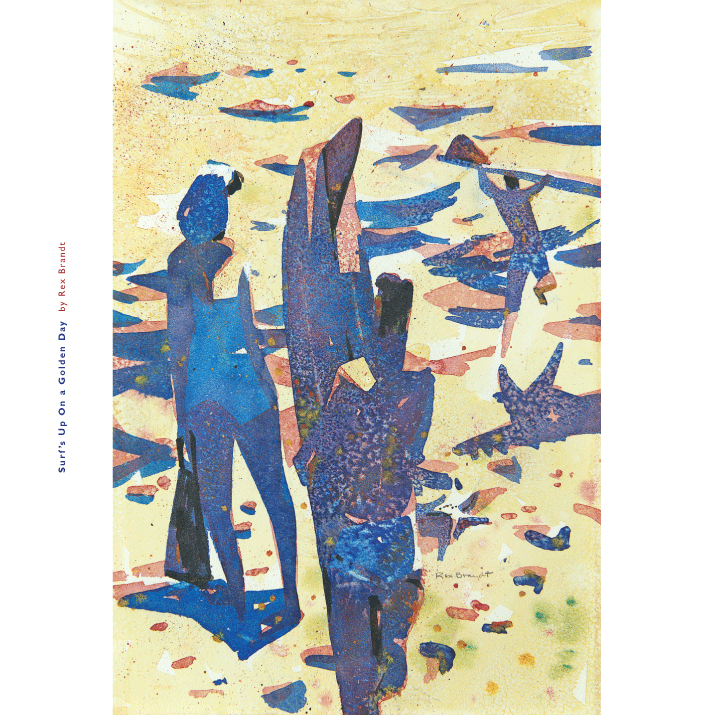
It’s uncommon to see a collection of this magnitude filled with such carefully selected pieces that are representative of the California Scene period, says Jean Stern, executive director of The Irvine Museum. “The collection is specialized and extremely high quality. The Hilberts are passionate about this period and have invested the necessary time and funds into getting the very best work.” In addition to watercolors, the collection contains some significant rare oil paintings, notes Stern. “The oils were expensive for the artists to paint, so they generally only did them for major exhibitions or as commissioned work.” As well as being less expensive, watercolors are portable and dry quickly, which allowed the artists to work on location. Janet Hilbert credits Mark for discovering much of the collection. “We have similar tastes in paintings, but Mark is the one with an incredible eye for exceptional pieces,” she says. “I’m often amazed at the paintings he uncovers.” Surf’s Up On A Golden Day

Museum in the Making

The Hilberts have loaned paintings from their collection to museums across the U.S., including local establishments such as Bowers Museum, Laguna Art Museum, The Irvine Museum and Long Beach Museum of Art. “During exhibitions over the years, Janet and I often heard people commenting how wonderful the genre was and how they’d never heard of the California Scene painters before,” says Hilbert. “This made us realize the value of creating a museum so that people could see examples of these paintings anytime.” After looking around Orange County for a location where the collection would be shown and appreciated, they decided to approach Chapman University. “We discovered that though Chapman has experienced tremendous growth over the last 20 years thanks to visionary leadership, they didn’t have a separate art museum that specialized in a particular genre,” says Hilbert. “We felt the collection would be a perfect fit for the university and Old Towne in particular, as it’s your quintessential California town.” When Chapman’s Executive Vice President of University Advancement, Sheryl Bourgeois, received the call from Hilbert regarding the donation of the paintings for the museum, as well as an additional $3 million to go toward building the facility, she was thrilled. “Mark and Janet are skilled collectors, and the collection is perfect for the school with its focus on California and Orange County and how the area became what it is today,” says Bourgeois, who notes that there are so many paintings in the collection that they can potentially curate endless thematic exhibitions.

Historic Villa Park Orchards Packing House

The Hilbert Museum of California Art will eventually be located in the Villa Park Orchards Packing House. Chapman’s president, Dr. James Doti, had the idea to house the museum in the building, which closed in 2006 and was once the largest citrus packing house in Orange. The permanent gallery space in the packing house won’t be ready until 2017, but the museum will have a temporary home beginning in the fall of 2015 in a facility located next to the Partridge Dance Center on Chapman University’s main campus. One painting you’ll likely see at the museum is the watercolor pictured in this issue. Rex Brandt’s “Surf’s Up On A Golden Day” is one of the Hilbert’s favorite pieces. Painted in the 1960s by Brandt, a well-known Newport Beach California Scene artist, the slightly abstract painting captures California’s natural light, “which is unique and unlike any other place on the planet except for a small section of North Africa,” says Hilbert. “California is known for introducing the surf culture throughout the world, and this painting does a marvelous job of conveying that culture.”

Published in the Jan/Feb 2015 edition of the Old Towne Orange Plaza Review

Written by Julie Bawden-Davis, Photographs provided by Chapman University and The Hilbert Collection

Notes From A Neighbor David Hockney in Santa Ana

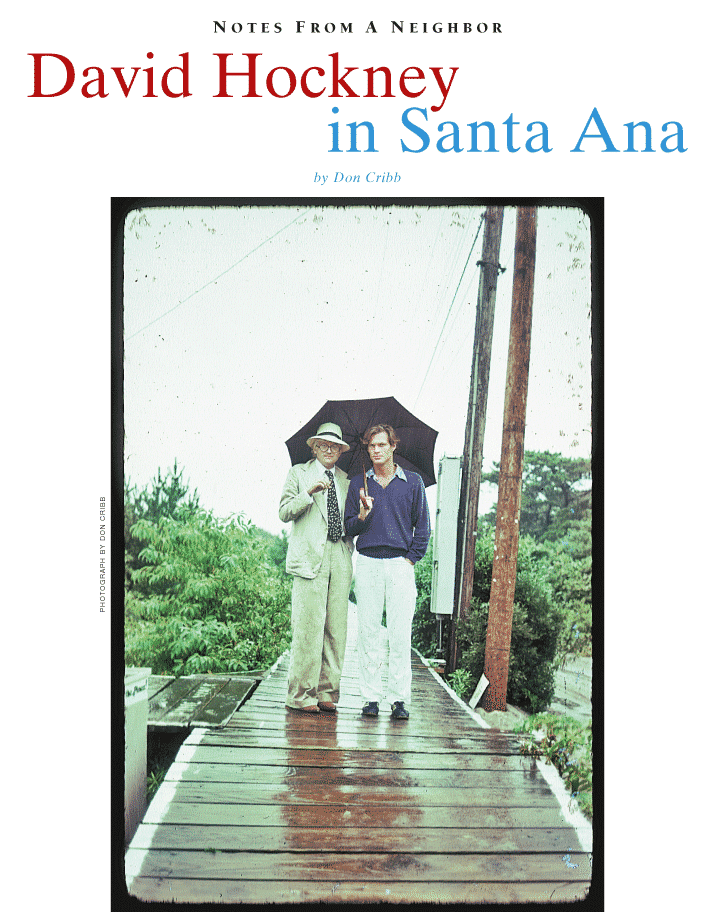
Recognized for his vibrant paintings of Southern California and compelling portraits, David Hockney is one of the most respected of today’s living artists. His work, which spans over half a century, gained notoriety during the Pop Art period of the 1960s.
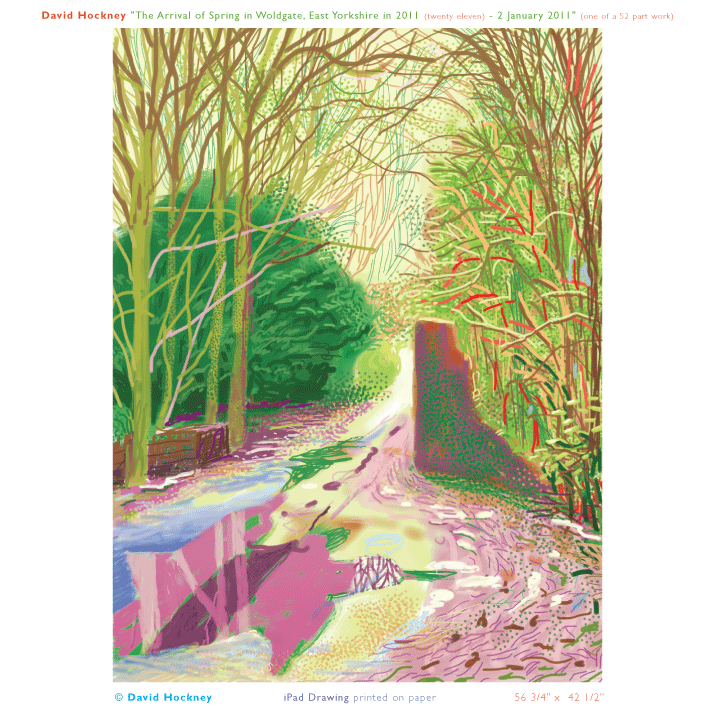
Though he is British, Hockney moved to Los Angeles after a trip to the area in 1964 and for the next 41 years lived in Hollywood Hills and on the Malibu coast. In the golden light of Southern California, he created numerous exotic landscape sceneries, including his iconic paintings of sun–drenched swimming pools. He has experimented with asymmetry, cubism and reverse perspective and helped create an important dialogue between photography and drawing. The juxtaposed photographic images he calls “joiners” have led to well–known works of art like “Pear Blossom Highway” (1986). Always open to new visual technologies, Hockney continues to remain viable as an artist. In addition to painting, drawing and photography, he has used in his artwork color copiers, color laser printers, FAX machines and most recently the iPad. Locally, it was an exhibition of Hockney’s work that helped launch the Santa Ana arts movement started in 1987. The artist’s exhibition at the Modern Museum of Art at Griffin Towers at MacArthur Place in 1989 announced that Santa Ana had serious intentions of becoming a center for art, artists and culture. The fact that an artist of such international repute displayed his work in Santa Ana, rather than a venue like the Orange County Museum of Art in Newport Beach where he’d been invited, brought major attention to Santa Ana’s arts profile. CNN, West German television and most local media were on hand when Hockney created the exhibit. The display included 36 faxed 8 ½” x 11” paper images of Malibu, which when assembled formed an ornate silver tea set on a table with a window view depicting powerful waves of surf crashing wildly onto a rocky shore. An archival serigraph poster was created to recognize this important occasion, and unsigned at $40 each they sold out. This successful exhibition helped Santa Ana overcome resistance from some local journalists who felt the arts “belonged” in Laguna and Newport beaches, and the display made it clear the intentions of the Santa Ana Council of Arts and Culture to make Santa Ana an enduring center for the arts. After years creating large–scale, richly–colored landscapes and portraits in Southern California, Hockney returned to England in 2005. Though he once referred to his homeland as “dreary and drizzly old England,” using his unique colorful interpretation he soon created a visual wonderland of East Yorkshire. Through his work, the British landscape became mythically imagined–a verdant land of gentle, proud and elegant beauty. On January 21, 2012, a very large exhibition of earlier and new Hockney works will debut at the Royal Academy of Arts in London
David Hockney
Note from the Author: David Hockney is a mentor and dear friend. We met at a Hollywood dinner party in 1969, and I was immediately drawn to his bohemian, yet stylish manner and his ability to transcend reality and see the world in a different light, conveying that difference in imagery that draws people into his work. I introduced David to Disneyland and Laguna Beach and he invited me to travel with him through Europe and the US. During those travels and my time spent with David, I also learned to see the world differently. Without David’s support, the Santa Ana Arts movement would not have occurred. David’s friendship inspired my work as an arts activist and appreciator and shaped the person I am today.

Published in the Jan/Feb 2012 edition of the Old Towne Orange Plaza Review

Written by Don Cribb, Photograph by Don Cribb

Inside Art With Moira Hahn


Moira Hahn: East Meets West in Vibrant, Satirical Paintings

On a brisk fall day in the early 1960s, Moira Hahn’s mother sent her out into their suburban Maryland yard to clear leaves from a patio. Rather than gather the scattered vegetation for disposal, the 7-year-old saw something completely different within the pile of nature’s bounty before her. When Hahn finished with her “chore,” the budding artist had raked the leaves into the shape of a hatted cowboy on a horse. Connecting decidedly different or even conflicting elements to create a compelling piece of art is the hallmark of this Long Beach artist, who has exhibited throughout the U.S. and Japan for more than 20 years. Bold and colorful, her paintings, which walk a tightrope between Western and Eastern themes and the past and present, elicit admiration, surprise, and more often than not a chuckle once a painting’s often satirical message becomes apparent. While some have described Hahn’s paintings as “Pop-Surrealism,” she doesn’t find this an accurate description of her work, which has its roots in classical Japanese art history—specifically Ukiyo-e (pictures of the floating world). The genre features woodblock prints and paintings popular from 17th–19th century Japan. “Nouveau Ukiyo-e might cover some of my work, because it contains elements from the contemporary and floating worlds,” says Hahn, who taught art at Santiago Canyon College for 10 years. Many of her paintings depict humanlike interactions regarding present-day topics between animals dressed in ancient Japanese kimono styles.

Born to Paint

Hahn has always gravitated to art. Throughout her childhood, she constantly created using materials she found on hand. Nature was—and continues to be—an artistic muse for her.
  • She made tea sets out of backyard clay.
  • In high school, she spent afternoons in the forest observing wildlife such as deer, badgers, and foxes.
  • She gathered plant materials for her artwork, including walnut shells she boiled to make brown ink.
As a high school junior, Hahn skipped a day of school to apply at the Maryland Institute College of Art (MICA) in Baltimore. She was immediately accepted after showing her portfolio.
  • BFA from MICA in 1977
  • Additional studies at CalArts in Valencia
  • MFA from California State University Fullerton in 2000

Asian Influence

Though it might seem unusual that a non-Asian artist would be interested in Ukiyo-e, it was a natural progression for Hahn, who comes from a family of artists and art appreciators.
  • Her father served in China during WWII and collected cloisonné and local crafts.
  • An uncle stationed in Japan in the 1960s sent back art to the family.
  • Her parents built a Japanese-style cedar house with Japanese furniture.
During her 20s, Hahn worked for five years as a studio assistant for a Japanese painter. She studied Japanese art in Hawaii in the 1980s. A pivotal moment came during a visit to Baltimore’s Walters Art Gallery in 1976 where she encountered an exhibition of Hokusai’s paintings, woodblock prints, and manga. “I was in awe,” she recalls.

Blue Moon

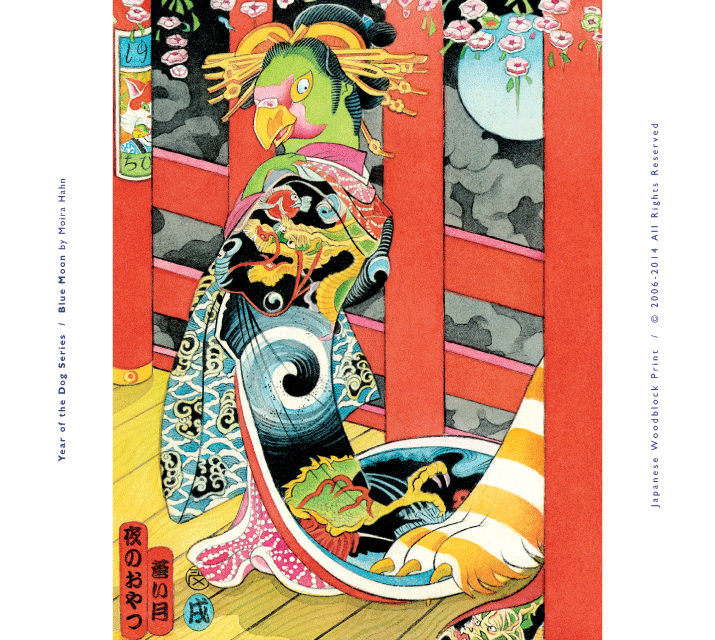
Moira Hahn Blue Moon The painting “Blue Moon”, pictured above, exemplifies Hahn’s east-meets-west style. A parrot seductively poses in a kimono while a large cat paw rests on the tail of her garment. At first glance, the parrot appears to be in danger.
“People worry about the parrot, but she’s fine,” says Hahn. “The birds hung up posters all over the neighborhood of the cats they intend to pick off.” (The parrot has an AK-47 hidden under her kimono.)
Art historian Meher McArthur, who has curated shows featuring Hahn’s work, adds:
“Moira is superb with the brush and has a wonderful sense of color. Her work is layered and rich. At first glance, the animals in her paintings appear to be cute, but then you realize something unsettling is occurring. The parrot in ‘Blue Moon’ is dressed like a 19th-century courtesan and is exposing the nape of her neck, which was considered very seductive. The subtitle of the painting (written in Japanese) is also compelling and amusing—‘Evening Snack.’”
In 2010, Hahn added to her collection a traditional woodblock print of “Blue Moon.” Crafted in Japan, it took a team—including a carver and an inker— more than a year to produce a limited edition of 200. “Having the print made was on my bucket list,” says Hahn. “It turned out beautifully.”

Explore More of Moira Hahn’s Work

Visit her portfolio and galleries online: Beginning March 22nd, Hahn will teach a watercolor technique class series at The Art Studio in Westminster. Learn more at theartstudio.us/place/watercolor.

Published in the Mar/Apr 2014 edition of the Old Towne Orange Plaza Review

Written by Julie Bawden-Davis, Photograph provided by Moira Hahn

Inside Art With Art Innovators

Despite studies that show learning about art is critical to development; in the last couple of decades art has fallen off the list of mandatory school subjects.  That means that in order to learn this skill, most kids must study the subject as an extracurricular activity.
Thanks to forward-thinking organizations like Art Innovators, which provides children with art classes at school and other community locations, kids lucky enough to be involved in the program are reaping the benefits of an art education.
“Several studies have shown a correlation between art education and achievement in other academic areas, which makes programs like Art Innovators so important,” says Anna Dress, Children’s Services Librarian for the OC Public Libraries, Westminster Library, where they recently hosted a series of classes by Art Innovators. “Creative thinking exercises the brain and stretches well beyond the arts—it encourages children (and later, adults) to ‘think outside the box,’ which is a skill they can apply to all areas of life.  Today’s little artists become tomorrow’s innovators, problem solvers, inventors and creators.”
“Where Creativity Takes Flight”
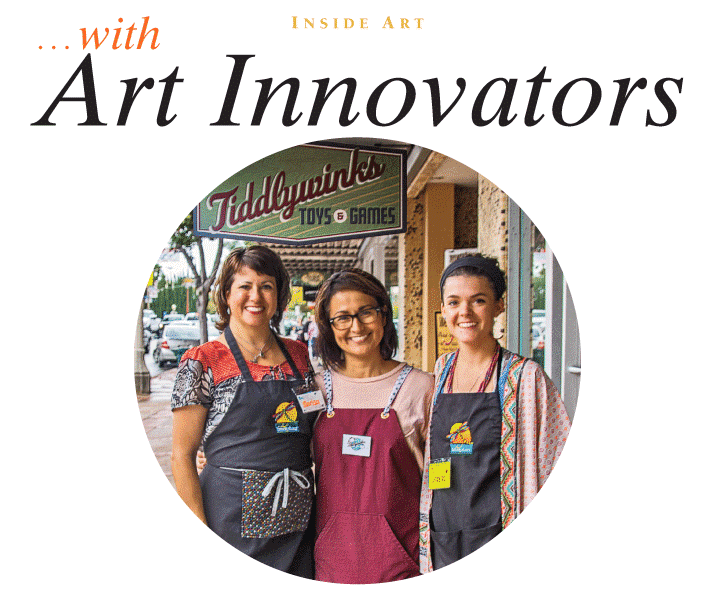
At Art Innovators, mother/ daughter team, Marisa and Sabina Timothy, offer kids the freedom to express themselves without any expectations.  “Our tagline is: Where creativity takes flight,” says Marisa. Sabina adds, “We give kids the opportunity to be free from ‘right’ or ‘wrong,’ and to express themselves however they desire.  This fosters in kids self-worth and confidence, and that positively affects every area of their lives.”
Opportunities to express themselves also lead to successful futures, adds Marisa.  “The irony is that we put our kids through the educational system with all of its testing, but when they graduate and get a job and are asked for their ideas, they freeze, because that type of creativity isn’t often fostered in schools.  While our class format is intentional and structured, we also allow the children freedom of expression.  They are often initially overwhelmed by that freedom, but they soon learn to work without any expectations, and a wonderful thing then happens —their authentic selves emerge in their artwork, which is wonderful to see.”
Everyone Has an Inner Artist
“We are all artistic in our own ways.  It’s a part of being human,” says Sabina.  “The truth is that we all need an artistic outlet of some kind.”
To bring out the inner artist in the children they teach, Art Innovators introduces kids to a wide variety of mediums and processes.  “Every class is an adventure, because we’re always doing something new,” says Sabina.  “Exposing students to a wide variety of styles has an added bonus of teaching them about various cultures that they might not have had exposure to otherwise.”
Art Innovators’ students have experienced a wide range of projects, including assignments inspired by American artist Keith Haring and the ancient art of Suminagashi (Japanese marbling), which features a process of marbling paper with ink and water.  They’ve also done projects featuring Egyptian, Native American and Ancient Greek art styles using a wide variety of media, such as pastels and colored pencils.
“We’re always amazed at the work created by the students,” says Marisa.  “The teachers, parents and the students themselves are surprised at how well they do.”
The caliber of the art pieces done by the students is of significance, since it’s the policy of the program not to touch student work or guide their hand at all, notes Sabina.  “One of my favorite experiences is to watch parents come in after class and see their surprise when students insist they did the artwork themselves.  It’s very empowering for the children to have their parents amazed and praising them for their work.”
Suzanne Mapes is the mother of eight-year-old Diego Garrido, who has taken Art Innovators’ classes for a year-and-a-half.  “Diego started when he was in first grade, and I was really impressed with the unique art pieces he created.  The philosophy at Art Innovators of building confidence and problem solving through art really clicked with Diego and me,” says Mapes, a professional photographer, who today teaches for the company.
The art on the inside cover of this issue is the work of Diego, who says that he wanted “to draw something outside of our universe.  I wanted to draw squiggly lines and straight lines, and so I did,” says Diego, who already has a 30-page art portfolio.
Freedom to Explore
Another unique aspect of Art Innovators is their use of permanent markers and no erasers.  “The inability to erase and start over teaches students to take a step back, take a deep breath and accept what happens,” says Sabina.  “When they do make what could be considered a ‘mistake,’ they learn to adjust to it.  This is a freeing, confidence building experience that spills over into all areas of their lives, including academics and sports.”
At the Westminster Library this past spring, they held a series of classes by Art Innovators during Orange County’s Imagination Celebration.  “We were fortunate to have our Friends of the Library pay for the classes, which we offered to our young patrons for free,” says Dress.  “The four stand-alone classes each taught varying artistic methods. The teachers were all kind and patient and genuinely cared about fostering creativity in the children.  I was truly impressed by the finished artwork the children were able to produce under their guidance, and the experience seemed to boost their self-confidence.”
Artistic Backgrounds
The Timothys became involved in Art Innovators after Sabina started working for the company in 2010.  “I found that I loved teaching kids art,” says Sabina, who personally enjoys a wide variety of art mediums, including designing quilts and sewing.  She started as an assistant and was soon promoted to instructor, eventually becoming an apprentice to the owner-director.
When the previous owners decided to sell the company in fall 2013, the first person they asked to take over was Sabina. Marisa, who is a certified re-designer working in interior design, had just left a fulltime position, so the mother-daughter duo decided to join forces and buy and run the business together.
“The business is going really well,” says Sabina.  “Our strengths complement one another.  We also both enjoy interacting with the parents and watching the kids’ confidence build.  Seeing their artistic styles emerge at a young age is beautiful to see.”
  For more information about Art Innovators, visit: oc55.artinnovators.com or www.facebook.com/artinnovators55

Published in the Jul/Aug 2016 edition of the Old Towne Orange Plaza Review

Written by Julie Bawden-Davis, Photograph by William Wallace

Inside Art A Major Collection in Our Neighborhood Phyllis and Rose Escalette

To view a major collection of art you usually have to buy admission to a museum, but Old Towne residents need only visit Chapman University. There on campus is the Phyllis and Ross Escalette Permanent Collection of Art consisting of more than 700 pieces of contemporary works.
“The collection, which features many Southern California artists, is unique in that you come across it as you make your way through campus,” says Chapman’s collection manager David Michael Lee. “It’s an organic approach to displaying art that makes it accessible.” Chapman’s curator Maggi Owens started the collection in 2000. “At the time, I had a modest budget, so I sought donations,” she says. “Artists were happy to donate and be part of the collection, and we obtained some wonderful pieces as a result.” (Since 2009, a $2 million endowment donated by Phyllis and Ross Escalette of Newport Beach has supported the collection.) One especially striking painting Owens procured via donation is “Station,” by Mary Addison Hackett, who resided in Los Angeles when she painted the piece and currently has a studio in Nashville. The colorful abstract is an oil on canvas that measures 60 x 48 inches and hangs in Beckman Hall, where a large concentration of the collection is located. “When I visited Hackett’s studio, that piece hit me immediately,” says Owens. “The colors blend so well, and there are a lot of angles to the piece, which gives it depth. I also like the movement. She’s a very good artist, and her work adds value to the collection.” Lee agrees that the piece makes a powerful addition. “The painting features an explosion of color, and it’s a great example of abstraction,” he says.
Phyllis and Ross Escalette Permanent Collection of Art
Hackett decided to donate “Station” when she saw that Chapman had collected works by artists whom she respects. “I wanted the painting to be cared for within a collection where it would be seen and hopefully inspire others,” she says. “The diversity and breadth of Chapman’s collection is an amazing resource for encouraging dialogue and gives students the opportunity to see art as a respected staple of daily life.” Hackett painted “Station” in 2008 while concentrating on large scale pieces. “At the time, I was interested in ideas surrounding landscape, architecture and technology,” she says. “The painting is not inspired by a particular event, but if it were, it might be something slightly futuristic. I remember the blue needed to convey an enveloping thickness. The title could reference a space station, a resting point between two places, or any other connotation of the word station.” Hackett’s work has shown in numerous California venues, as well as nationally and internationally. She’s exhibited at Torrance Art Museum, Kristi Engle Gallery in Los Angeles and Irvine Fine Arts Center. According to the artist, her work is prompted by her experiences, actual or embellished events and memories from her life. “My first influence was my family. They gave me books and subscriptions to art magazines like ARTnews and Art in America when I was still in single digits,” she says. “When I started painting, the Neo-expressionists were a major influence, but then I spent the 1990s in Chicago where there was a dearth of painting and an abundance of theory. I moved to LA in 2000, and suddenly I was in an oasis of painting.” A sampling of that oasis can now be seen at Chapman.

Published in the May/Jun 2012 edition of the Old Towne Orange Plaza Review

Written by Julie Bawden-Davis, Artwork image provided by Chapman University

Inside Art With Judy Schroeder

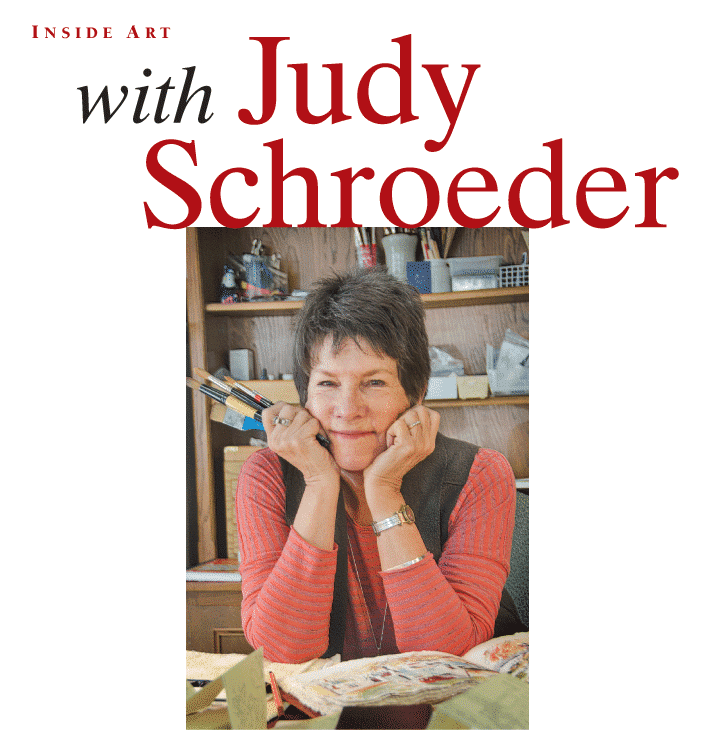
Growing up in Escondido’s countryside during the 1940s and 1950s on an avocado and orange grove, Judy Schroeder kept herself busy with art. She drew clothing for her paper dolls, created small paintings for her room and each month when Ford Times Magazine arrived, she couldn’t wait to see the paintings reproduced in the little magazine. The digest-sized publication featuring watercolor illustrations by well-known artists of the time intrigued the budding artist.
“The publication was the perfect size for a kid,” says the professional watercolorist, who owns Schroeder Studio Gallery in Orange, which specializes in water media. “I didn’t read a word, but I pulled the watercolor illustrations out of the magazine. I especially remember admiring the work of influential California watercolorist Rex Brandt.”

California’s Watercolorists

That early interest in the art of watercolor compelled Schroeder to gain an education in art and forge a career in the craft. She has taken lessons from notable watercolorists, including Brandt, Roger Armstrong, Gerald Brommer, Keith Crown, Millard Sheets, Robert E. Wood and Milford Zornes. Today she is a recognized painter and author and teaches art at the gallery, which she opened in 1998 in Old Towne and runs with her daughter Katie Schroeder, also an artist. The busy gallery, which specializes in watercolors and art glass, represents the work of more than 100 artists from around the country and regularly holds receptions and offers educational workshops from well-known artists. Schroeder’s work, which also includes integrated collage, has appeared in individual and group exhibitions and is collected. In 2003, she participated as one of 17 artists selected worldwide to write a chapter for the book Work Small, Learn Big: Sketching with Pen & Watercolor. Closer to home, in 2006 the Orange Public Library Foundation commissioned her to create 13 paintings displayed at the main library representing Orange’s history.

Painting on Location

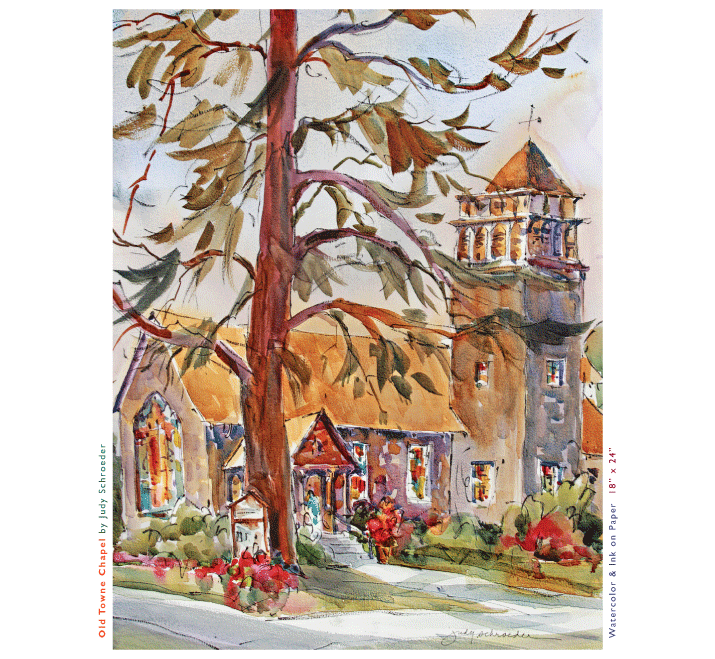
Harkening back to her roots in the country, Schroeder’s subject matter tends to be landscapes, which she prefers to paint on location. Though she has painted in some picturesque spots all over the world, including, France, Italy, Portugal and Western Samoa, she finds equally compelling material in Old Towne. “I just walk out of the studio and around the corner,” says Schroeder, who has painted Plaza Park many times. The painting in this issue of the Chapman Chapel on Maple and Grand is another example. Judy Schroeder's Chapman Chapel

Chapman Chapel

Schroeder drew the chapel painting on location using an ink brush and then added watercolor. “The brush creates fine lines that seem to dance on the page,” she says. “With the painting of the church, I put the tree in first and noticed that it was looking a little thin. I thought about filling it in, but decided to leave it as is, and I’m glad I did, because today the tree is gone.” The painting is not Schroeder’s first of the church, which reminds her of a tiny chapel she attended as a child. She often returns to the same scenes in Old Towne to capture varying perspectives. “When you change a vantage point, you often see something new,” she says. “I enjoy tackling challenges in the scenes I paint. With the chapel, the tower is prominent and can take over the painting if you’re not careful.” Schroeder also enjoys painting on location in Orange because of the rich history of many of the buildings, including Chapman Chapel, which was originally Trinity Episcopal Church and dates back to 1909. “It was the first church designed by the well-known architect Philip H. Frohman when he was a young man,” she says. “Frohman went on to gain fame working on the Washington National Cathedral. Even when she is painting the same scene, Schroeder strives to challenge herself. “It’s important to continually give yourself problems to solve, because it’s the only way you’re going to grow as an artist,” she says.

Gerald Brommer at Schroeder Galleries

Renowned California watercolorist Gerald Brommer knows Schroeder and holds art workshops throughout the world, including Schroeder’s Studio Gallery. “Judy selects her subject matter well, and she does an especially good job with those subjects close to home,” he says. “She loves the state, and it comes through in her work. Her California paintings are some of her strongest.” Working on location is another part of Schroeder’s formula for pushing herself. Painting amid the hustle and bustle of a scene when things could change in a moment’s notice presents its challenges, but Schroeder enjoys getting the full effect of the scene. “It’s exciting to be on location; you can smell things and touch them, and you’re not limited to memory or a photo.” Schroeder also finds the artist’s community at the gallery, including her many students, to be invigorating and to benefit her art. “Teaching and painting feed one another,” says Schroeder, who has a B.A. with a Special Secondary teaching Credential in art from the University of Redlands. “When students realize that they can actually paint and begin noticing things they never did before, that inspires me. People walk around with blinders on when it comes to the colors and shapes around them, and it’s a privilege to watch them take them off.” For more information about Schroeder Studio Gallery, visit schroederstudio.com.

Published in the April 2013 edition of the Old Towne Orange Plaza Review

Written by Julie Bawden-Davis, Photograph by Jeanine Hill, Artwork by Judy Schroeder

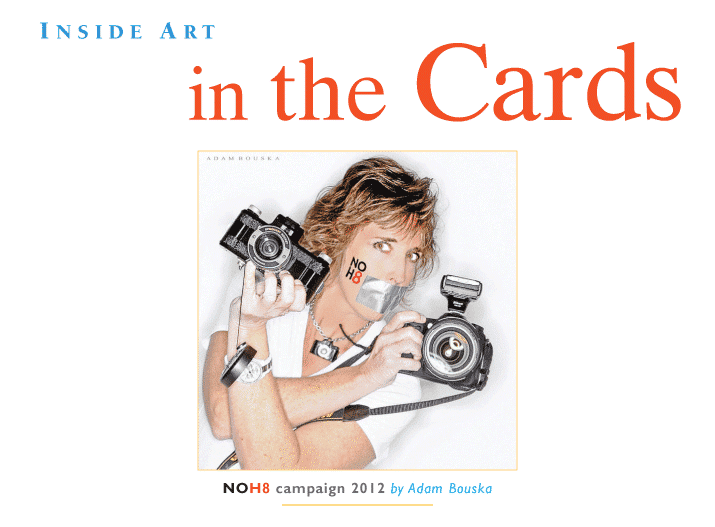
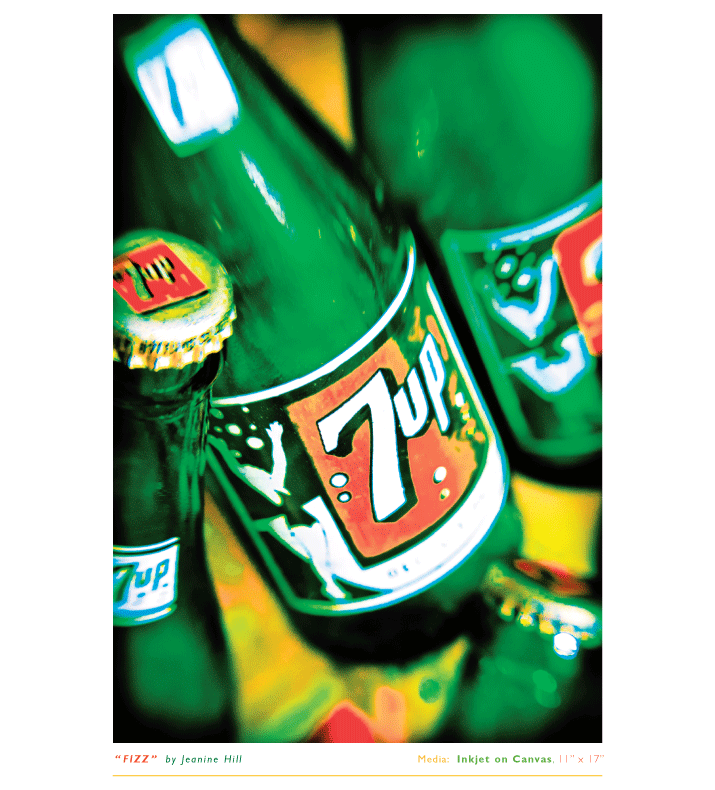
Inside Art In The Cards Jeanine Hill

Though photographer Jeanine Hill is skeptical about tarot card reading, she thanks the ancient practice for her art. In 2009, while enduring a period of deep depression, Hill stumbled upon a tarot card reader in a little shop in Costa Mesa. On a whim, she decided to have her cards read, and what came out of the meeting led her onto a new path.
“The tarot card reader asked me about my biggest passions, and when I told her photography and flea markets, she suggested that I take my camera to a flea market,” says Hill, who has lived in Orange most of her life and worked as a professional photographer since the mid-1980s. Taking the advice, Hill visited flea markets and captured photos of vintage items like soda bottles, manual typewriters, classic toys and old alarm clocks-soon finding the depression lightening and a new passion for photography emerging. Because the tarot card reader’s suggestion went so well, Hill returned for a second reading and was urged to submit her work to art shows, which she started doing two years ago. Her first show was at the San Francisco Museum of Modern Art, which featured a soda image, Victrola record player and a 1940s telephone. Since that show, she’s been in several others and will appear in the Ménage A trois No. 8 show in Long Beach on September 15th. Though her photos seem artfully posed, most of Hill’s work is of scenes just as she finds them. “I do look for situations with vibrant colors like greens, but otherwise what I see is generally what I shoot,” she says, noting that she does very little photoshopping-generally just intensifying colors when necessary.
Jeanine Hill
In the 7UP photo pictured above, Hill came across the bottles and shot them as they appear using a bendable lens that allows her to create special effects. “I was drawn to the intense colors of the bottles and the label has an art deco lady, which I love,” she says. Nicki Braun is an art major, who collects Hill’s work. “What I enjoy about Jeanine’s photos is that many are of vintage items and the colors really pop,” says Braun. “She also shoots at unusual angles, and there’s a lot of energy in her work.” Hill knew that she wanted to be an artist by the time she was eight and got her first camera at 14. After graduating from the Art Center College of Design in Pasadena, she started her career as the first woman photographer for Northrup. Finding the corporate life not for her, at the age of 24 she opened her own photography studio in Orange. For many years she shot car wheels, as well as free-lanced for Disneyland, where she photographed famous people like Gerald Ford, Elizabeth Taylor and Michael Jackson. “Orange and Orange County have been good to me,” says Hill, who has also worked for Chapman University. “When I told people at the Art Center I’d be going to Orange County after graduation, they thought I wouldn’t make it, but here I am 26 years later. Orange is my town.” See Hill’s artwork by visiting JHillPhoto.com.

Published in the Sep/Oct 2012 edition of the Old Towne Orange Plaza Review

Written by Julie Bawden-Davis, Photographs by Adam Bouska & Jeanine Hill

Inside Art With Leigton Hubbell

In 2001 in the wake of the dotcom bust, Leighton Hubbell had the good fortune to be laid off from his job at a large branding agency. Within a short time, the award winning illustrative designer found himself setting up shop at home.
“We were two weeks into buying our house in Orange, and my daughter was barely 9-months-old,” says Hubbell, who at the time had worked in design since 1993 for a wide variety of companies, including international corporations representing brands such as Pepsi Cola and Motorola. “Then out of the blue, a former client called my home office to say she was working on a new venture and wanted me to meet the owner about doing some design work.”
Hubbell landed the job, which proved lucrative enough for him to outfit his home office. “One moment I was dead in the water without a computer, and the next I was depositing a substantial check and buying equipment,” he says. “Things got rolling from there, and I haven’t looked back.” As creative director of his one-person design shop based just outside Old Towne, Hubbell does everything from creating logos, corporate identity systems, promotions and packaging design to branding, illustration, print, web design and television work. He is probably the most well-known for his logos and icons, an area of his design work that developed over the years in response to market demand.

The Making of a Logo

“Back when I worked for advertising agencies, I ran across horrid logos, and I couldn’t always do anything about it, because they weren’t my clients,” he says. “Now, considering that a logo is a visual calling card for a company, I feel it’s my obligation, when necessary, to lead my own clients to a whole new look. Today, logo design, which is a specialized, unique skill, is a big part of my business, and it’s experiencing a renaissance thanks to the use of logos and icons in technology such as mobile phone devices.”
Creating a logo is an organic process for Hubbell. “I don’t just make a logo,” he says. “I do a lot of thinking, planning and research, including examining the trends and what competitors are doing and talking to the clients in order to understand what they want. Each logo is completely customized and done in a style that best fits the client.” Leighton Hubbell icons

Untappd Badge Icons

Icons, which are symbols used for purposes such as making statements or identifying or announcing products, are also a mainstay for Hubbell nowadays, especially with the advent of social networks. The icons pictured on page 2 of the Plaza Review were commissioned by Untappd, a social network similar to Foursquare that allows users to share and explore the world of beer with friends and people all over the globe. After creating an account and profile at untappd.com, users check in with information such as where they are drinking beer, what they like about certain beers, when they try out a new beer, attend a beer festival or celebrate a special occasion with beer. When they complete various activities through the network, users earn badges, which feature the icons. Hubbell came up with the design concept for the icons and created many of them. (They are now being created in-house.)

Born to Illustrate

Coming from a family of artists, including a paternal great grandfather who was a painter and a maternal great grandfather who was a label illustrator for a fruit packing company, Hubbell showed an interest in art from a young age.
“I was always drawing and experimenting with art mediums,” says Hubbell, who took art classes throughout his childhood. “When I was in first grade, my mother gave me modeling clay. I responded by duplicating some of her ceramic work, which amazed her. By the time I was in junior high school, I knew that I wanted to go into design or commercial art.”
Hubbell attended art school out of high school studying graphics, advertising and typography. He studied at The Art Institute of Colorado from 1987 to 1989 and then the prestigious Art Center College of Design in Pasadena, where he graduated with a Bachelor’s in 1993. Professional photographer Will Hare, who is based in Old Towne and took the photo of Hubbell that appears in this issue, first met the designer at Art Center, where he attended as a photography student. “Leighton and I did a project together, and we hit it off right away,” says Hare. After graduation, the two lost track of each other until 1997 when they found that they both lived in the Old Towne area and soon became good friends. Hare’s history with Hubbell gives him a bird’s eye view of the artist’s career.
“Leighton has always put pencil to paper, and it is his ability to draw that lends itself nicely to his work, especially logo design,” says Hare. “He’s a genuine person with a sense of humor and sensibility, and as he’s matured over the years as a person and an artist and become comfortable with himself, he’s found his voice, and that voice comes through in his work.”
For more information about Leighton Hubbell and his work, visit LeightonHubbell.com.

Published in the July/Aug 2013 edition of the Old Towne Orange Plaza Review

Written by Julie Bawden-Davis, Photograph by Will Hare, Artwork by Leighton Hubbell

Jon Haverstick

View the photographic work of Jon C. Haverstick and one prevailing theme overrides—humanity. With his camera, Haverstick strives to communicate as much as possible about his photo subjects. “The human interest element is critical for me,” says Haverstick, an award winning professional photographer and photography instructor based in Santa Ana. “While there’s certainly a lot of interesting photography without a human element, my interest is in portraits. For me, it’s about telling people’s stories.”

Faces of Freedom

It is this desire to open a window to the soul of those he photographs and his respect for the U.S. Armed Forces that led the photographer to undertake his “Faces of Freedom” project pictured in this issue. Consisting of portraits of veterans, the project that he started in August 2011 has about 50 photos and counting of men and women who have served the country in various wars, such as Vietnam and World War II. “Many veterans don’t have good portraits of themselves that depict their service to the country,” says Haverstick, who gives participants complimentary portraits. “This project provides a way to honor veterans and serves as a reminder of those who have given up so much so that we have what we do.” Haverstick has several relatives who have served, including his father, father-in-law, nephew and son, who is currently in the Army. One participant of the Faces of Freedom project is Pastor Frank Orzio, a retired Marine Sergeant and two-time Purple Heart recipient, who is founder of The Wounded Warrior Ministry (http://thewoundedwarriorministry.com). “Jon is a great guy who goes out of his way to honor veterans and preserve their legacy,” says Orzio. “He doesn’t do any of this for personal gain. As we say in the Marine Corp, he has uncommon valor.” Jon Haverstick Faces of Freedom

Healthcare and Photography

Haverstick attributes his sensitivity to people and affinity for capturing them on camera to growing up in the 1970s with a disabled foster sister and being surrounded by a family involved in community service and healthcare. Haverstick himself spent more than 20 years in the medical field as a genetic counselor and in healthcare education prior to opening his photography company in 2011. Though healthcare seems light years away from photography, the skills he learned help him take the candid shots he does today. “In healthcare, I learned how to talk to people in a vulnerable state and be sensitive to their concerns and emotions,” he says. “Those people I photograph also often feel exposed and nervous.” Photography student Heather Rollins considers Haverstick her mentor and comments on his ability to put photographic subjects at ease and share their personalities through their portraits. “Jon has a way of catching the character in people, which isn’t always easy to do,” says Rollins. “He has a gift for building rapport with his clients and making them feel comfortable.”

Drawn to Photography

Though he didn’t open his photography business until later in life, Haverstick was drawn to the art form from a young age. During high school, he shot photos for his school newspaper and yearbook and worked as a second shooter for a wedding photographer. At the time, he bought his first professional camera, a Nikon F2AS Photomic, which he used until he went digital in 2005. As an adult, he took many photos of family and friends and began teaching photography classes in 1999 at schools such as Santiago Canyon College, where he still teaches. “Teaching is a great outlet for me,” says Haverstick, who developed his own digital photography classes. “I’m passionate about passing on knowledge.” A desire to become a better photographer inspired Haverstick to leave his healthcare job nearly three years ago and open his photography business. With encouragement from his wife, Chiaki, and children, Cat and Conner, Haverstick quickly became successful. He does a wide variety of photographic jobs, including weddings, senior portraits, commercial and corporate work and fine art photography. With all of his work, Haverstick makes sure to interject the human element. “I shoot for Mercedes Benz and try to get a person in the photo whenever possible,” he says. “And when I do corporate work, instead of standard headshots, I like to show personality by photographing people interacting with their workspace.” To view the Faces of Freedom project, go to http://jonhaverstickstudio.com/faces-of-freedom-project/nggallery/page/1/.

Published in the Nov/Dec 2013 edition of the Old Towne Orange Plaza Review

Written by Julie Bawden-Davis, Photographs provided by Jon Haverstick

Inside Art With Jim Draughon

During a 20-year period when Jim Draughon collected numerous pieces of art for his extensive art collection, a question loomed at the back of his mind. “Every time I bought an artist’s work, I thought about how much I enjoyed painting as an undergraduate art major,” says the Orange resident. “I’d look at my new acquisition and think, I can do this,” recalls Draughon, who built a successful career in land development during his hiatus from art in the 1980s and 1990s. Finally, in 1998, Draughon heeded his inner voice and returned to art. “When I jumped into painting again, I started with watercolors and then transitioned into painting in oil,” says the artist, who chose to take up painting en plein air, which is a French term that means “in open air.” The popular contemporary California art movement involves painting outdoor scenes on the spot to capitalize on natural light and capture scenes in a true sense.

En Plein Air Painting

Draughon’s subject matter, which is primarily the California landscape, lends itself well to the en plein air painting method. “I love painting the California landscape, because the wide variety of scenes to paint are incredible,” says Draughon, who focuses his efforts on the state’s deserts and coast.
“The desert has a wonderful muted light that becomes intense in early morning and late afternoon, at which times the colors become rich and varied,” he says. “I also enjoy capturing the various rock forms and vegetation in the desert, and the coast with the water, waves and shoreline offers dramatic subjects.”

Boulder Hopping in the Desert

The painting pictured in this issue known as “Boulder Hopping” is a 9×12 oil on canvas painted in 2011 in Andreas Canyon, which is located in the Coachella Valley. Draughon and his wife, Vivian, own a vacation home in Palm Canyon outside of Palm Springs, and many of Draughon’s paintings depict this region.
“Andreas Canyon contains great geological forms, and there is a creek running through the area year-round,” he says. “I was with a painter friend when we found that particular scene, which had a nice composition with the mountain backdrop and the boulders in the water.”
Draughon feels “Boulder Hopping” is successful because it has rich colors in details such as dead fronds on a palm tree. “The burly, rough leaves on the palm are actually very colorful and create a more authentic representation of the tree,” he says. Jim Draughon Painting Boulder Hopping

Capturing Untouched Landscapes

Christine Thompson is co-owner of Copperwood Artware in Old Towne, where Draughon has shown his work since the gallery opened in 2004.
“Jim’s work consists of location paintings in truly untouched areas of the state that people familiar with the areas recognize,” she says. “You won’t see any human touches like telephone poles in his paintings. Oil painting is challenging in its own right, and especially en plein air. Some artists have a tendency to overdo oils by becoming heavy handed, but Jim doesn’t do that. His colors are authentic and strike a perfect balance.”

Born to Paint

Draughon was born in Texas but raised in Denver. As a child, he spent most of his time drawing and painting and even had his first gallery show right out of high school. Soon after that experience, he joined the Navy and spent some time stationed in various locales, including Japan. When he left the service at 22 in 1973, Draughon earned an AA in fine art from El Camino College and a BFA from California State University, Fullerton in 1976. He wanted to pursue a career in art, but opted for a steadier paycheck, going back to graduate school for a degree in Landscape Architecture at Cal Poly Pomona, which led to working in land development. Today, Draughon works as a real estate development advisor and is able to devote time to his art.
“I started painting 15 years ago after a long hiatus, because I’ve always enjoyed the process and the end product,” he says. “I don’t think I would want to rely on art as a main source of income, because that would make it feel like a job, but it’s been great to accumulate paintings and exciting that people purchase them.”
Visit Draughon’s website at jadraughonart.com. Meet the artist and see his work at the October 5th opening of the “Art by the Foot” show at Copperwood Artware located at 148A North Glassell in the Plaza.www.copperwoodartware.com, or call 714-633-8374 for information.

Published in the Sep/Oct 2013 edition of the Old Towne Orange Plaza Review

Written by Julie Bawden-Davis, Photograph by Jeanine Hill, Artwork by Jim Draughon

The Painter Within Kim VanDerHoek

When Kim VanDerHoek won a poster contest in kindergarten and received art supplies as her reward, she stifled disappointment over not getting a trophy like the second place winner. In retrospect, she realizes the oil pastels and watercolors were an excellent choice for a budding artist.
“The world may not give you what you want, but it gives you what you need, and I used those art supplies,” says VanDerHoek, who has won awards for her oil paintings, which are shown at Copperwood Artware Gallery in the Plaza. “I even saved the oil pastels and used them in college.” Although she earned a Bachelor of Fine Arts from California College of the Arts in 1993, VanDerHoek didn’t discover the painter within until 2005 after leaving her 11-year career as a graphic designer to have her first child. When her son Jordan was 10 months old, she took a plein air (outdoor) painting class as a creative outlet and found more than a hobby. “I’d searched my whole life for the thing I was passionate about, and it was painting all along,” she says.
Kim VanDerHoek
VanDerHoek quickly built a body of work and began marketing her paintings online and in galleries while continuing to study the craft. By 2008 she started entering shows and competitions and at the time painted a series of oil pumps at a location in Anaheim, which attracted attention. “People responded positively to the paintings, and one in particular I titled ”Locally Grown“ turned out really well, so I entered it in competitions and it started winning,” says VanDerHoek, who was a finalist in the 2011 American Artist Magazine’s cover competition. She painted “Rocky Shores of Crystal Cove” pictured in this issue of the Plaza Review, on an overcast day at the beach in June 2011. “A painter looks for a focal point to draw viewers in and then rewards them with eye-candy once they’ve captured their attention,” says VanDerHoek, who also teaches painting classes. “When I initially saw the view in this painting, I knew what to do in terms of painting the rocks and shoreline to create a sense of depth and bring you into the painting, from there drawing the eye to the cottages and people in the background.” While it is difficult to capture movement in a painting, VanDerHoek does so in the “Rocky Shores of Crystal Cove,” says Kimberly Haas, who owns Copperwood Artware Gallery with partner Christine Thompson. “When I look at the painting, I picture a crowd of people standing on the beach behind Kim as she paints.” The gallery will feature VanDerHoek’s work in a solo exhibition from September 14th through October 14th. “Kim’s vision is unique,” says Haas. “She is one of those artists capable of capturing the magic in a square box. It’s been a pleasure to see her evolution as an artist, and we’re excited for her to have her own show.” For more information on the artist, visit KimVanDerHoek.com. Find Copperwood Artware at CopperwoodArtware.com.

Published in the Sep/Oct 2012 edition of the Old Towne Orange Plaza Review

Written by Julie Bawden-Davis


Building Character Dr. Vernon Smith & Dr. Stephen Rassenti

Dr. Vernon Smith & Dr. Stephen Rassenti

One of Vernon Smith’s earliest memories involves fixing a broken clock. “I was under the age of six at the time, and I vividly remember the thrill of taking apart the clock, putting it back together and seeing it work again,” says the Nobel laureate. “Although today I realize physics was at play, at the time it was pure magic to find that actions create reactions.” Today, Smith, who has joint appointments with the Argyros School of Business & Economics and the School of Law, is still driven by a deep desire to find out why and how things work. It was this curiosity about the effect of social connections on economics that led to his 2002 Nobel Prize in Economic Sciences and in 2008 to his founding Chapman’s Economic Science Institute (ESI). Smith’s pioneering work examined for the first time how human behavior affects economies, which launched economics from a static science to an experimental social science. The research is somewhat complicated for the average person, but the bottom line is clearly grasped–human motives and actions dictate economic outcomes. The genesis of Smith’s theory started in the fall of 1948 during his last year studying electrical engineering at Cal Tech. At the time, he became interested in economics and human behavior and less enamored with the study of mechanical objects. “When I graduated in the spring of 1949, I was pretty sure I didn’t want to stay in engineering, so I made the decision to go back to Kansas University and get a Master’s degree in Economics,” says Smith. After that he attended Harvard and upon graduation accepted an appointment at Purdue in Economics, where he began teaching. “I realized that I didn’t really know anything about the relationship between economic theory–even elementary supply and demand–and what people actually do in the markets,” he recalls. “I became intrigued and did some investigating and found that it wasn’t just a failure in my understanding, but there had been no research on the topic.” Over the years since that initial discovery, his work has covered a broad range of economic subjects, including asset markets in the 1980s, and not surprisingly, the current economic crisis, which has spurred a host of studies. “The fact is that the stock market .com crash didn’t bring down the economy,” he says. “Investment brokers and the Securities and Exchange Commission prevented that a long time ago. You can’t buy stock with other people’s money, because you are subject to strict margin requirements, but in the run–up to the crisis you were able to buy homes with other people’s money, and that’s where the problems start.” While Smith is in demand as a speaker and does travel extensively, his first allegiance is to his work in the lab and sharing his knowledge with students. “I think it’s important to continue to discover new things, because if you don’tbalance educating yourself with speaking, you’ll soon find that you’re talking about things that are no longer relevant and immediate,” he says.

Dr. Stephen Rassenti

After receiving his bachelor’s degree in mathematics, Chapman’s head of the Economic Science Institute (ESI), Stephen Rassenti, worked as a carpenter in his native Canada. Fortunately for the world of Economic Science, after six years wielding a hammer he changed his focus and attended the University of Arizona where he met Vernon Smith. “I was studying for a PhD in systems engineering and had a minor in economics,” says Rassenti. “I took a class in economics with Vernon, and that really piqued my interest in the topic. In 1984, after two years working with Bell Laboratories, Vernon offered me a position as a research scientist in the economics lab, and we’ve been working together ever since.” After Arizona, Smith and Rassenti moved the economics lab to George Mason University in Virginia and then to Chapman. “Our move to Chapman was especially exciting because the University has been very accommodating, and the school’s vision dovetails with ours,” he says. For Rassenti, an exciting part of his work in Economic Science has been the human element. “Engineers presume that when they ask people something they will get perfect information that will enable them to execute plans based on the answers they receive, but the problem is people don’t always tell you the truth, which is where the behavioral element comes in.” Rassenti is especially pleased that the work he does has a positive influence. “The experiments we do in ESI have a dramatic financial impact in the real world,” he says. “We have the tools in the laboratory to test items such as healthcare or energy policies in order to see whether viable options are being proposed, which can potentially save the country billions of dollars, and that’s very gratifying.”

Wilkinson Hall

Built in 1904, Wilkinson Hall is the oldest structure on the Chapman University campus. This two–story, 26,510–square foot building, which is listed in the National Registry for Historical Buildings, was originally built to house Orange Union High School’s turn–of–the–century students. The impressive neo–classical structure was the high school’s only building for several years until enrollment increased substantially and new buildings were added, culminating with the construction of Memorial Hall in 1921, which was situated directly behind Wilkinson. The following year, Wilkinson was moved 300 feet northeast to its current location–a better vantage point in the center of campus with a less formal quad. Kress House Moving Company of Los Angeles relocated the building for $8,300. Wilkinson Hall houses the Economic Science Institute (ESI), and the departments of English, Humanities and Social Sciences.

Economic Science Institute

When it comes to economics and how we spend our money, questions abound. Chapman University’s Economic Science Institute (ESI) is dedicated to seeking answers to these age–old queries. The mission of the institute, which is located on the first floor of Wilkinson Hall, is to study and understand human socioeconomic behavior. Founded in 2008 by Vernon Smith and his colleagues Stephen Rassenti, John Dickhaut, David Porter and Bart Wilson, the seeds for ESI were planted many years before. In 1956 while teaching an introductory economics class at Purdue, Smith conducted his first experiment which eventually led to his groundbreaking theory of Experimental Economics. That theory resulted in his receiving the 2002 Nobel Prize in Economic Sciences. Vernon Smith and Stephen Rassenti, director of ESI, share their backgrounds and insight into the development of Chapman’s Experimental Economics laboratory.

Published in the Sep/Oct 2010 edition of the Old Towne Orange Plaza Review

Written by Julie Bawden-Davis, Photograph by Diane Prendergast


Building Character Dr. Michael Fahy

Dr. Michael Fahy

Back in 1982 when Michael Fahy had some time to himself one weekend, Chapman’s Associate Dean of the School of Computational Sciences had an eureka experience when he bought a computer graphics book at the local bookstore and experimented with the concepts on his home computer. “I spent the whole weekend writing computer graphics code and watching the results display on the screen,” says Fahy, whose prior experience with computers occurred a decade earlier at UC Santa Barbara when he worked with Fortran, a programming language used for numeric computation and scientific computing that like other programs used punch cards at the time to record data—a process Fahy found uninteresting.

Early Personal Computers

“After the Fortran experience, I didn’t look at computer science for more than a decade until personal computers hit the scene,” says Fahy. “That particular weekend with the computer graphics book, I was so engaged by the process that I didn’t get much sleep. I was completing tasks on the computer that I had previously done with pencil and paper with mathematics, and I really enjoyed being able to see things clearly and accurately as opposed to my hand drawn sketches.”
At the time, Fahy lived in New York City, where he was born and raised. That weekend experience interested him so much that he started a computer software company with his wife, Melodee, which they ran for 15 years in New York and continued with when the couple moved to California in 1989 so Fahy could join Chapman’s faculty. “We built client networks, connected computers and wrote software to make the networks run. In the beginning, we uploaded software to client sites using modems,” says Fahy, also a professor of mathematics and computer science at Chapman, who has a PhD in mathematics from UC Santa Barbara.

Brandman University’s Network

Fahy’s experience owning a computer company and his mathematics skills prepared him for the various roles he’s played at Chapman over the years. For 10 years from 1996-2006 he served as the university’s Chief Technology Officer, which included developing Brandman University’s area-wide computer network. “Back in the mid-90s, we were discovering the possibilities of what could be done with networking technology, and it was an exciting time,” he says.
“Michael played a huge role in expanding what is now Brandman University” (the university is a separate institution within the Chapman system), says Michael Mahoney, PhD, executive vice president/provost for Trident University International. “Back in the 90s when the general public was just starting to use the internet, he was the person behind connecting all of those external Chapman sites under the Brandman umbrella, which was really impressive, because there was no blueprint for doing so.”

Big Data and Computational Science

When he finished the Brandman network, Fahy moved on to his current project developing Chapman’s new School of Computational Sciences, which has allowed him to combine his interest in math and computer science.
“Computational science has its roots in math and computer science and is used to tackle big data problems in order to answer some of the world’s most complex questions in a wide variety of fields, including science, biology, academics, climate and economics,” says Fahy. “For instance, computational science has been used for purposes such as examining cancer treatments.”
Fahy began developing Chapman’s School of Computational Sciences within the Schmid College of Science & Technology in 2009, using as a guide the first computational science program developed in the country at George Mason University in Virginia, which started its program in the 1990s. Chapman now has a M.S. and PhD. In Computational Science, and Fahy has coordinated partnerships with area businesses so that students can learn from real world experiences.
“Considering that personal credit scores are based on massive amounts of data extracted from people’s purchasing history, we created a partnership with Experian,” says Fahy. “A faculty member spent a period of time at Experian last summer observing in order to gain real world knowledge to develop the curriculum.”

Idea Incubator

The computational sciences department is located in Von Neumann Hall, and the hub of activity is a large warehouse-style room with white boards spanning the walls, as well as a ping pong and pool table and a piano. It is here that students and faculty gather to brainstorm and where the department hosts various events. “The formulas on the white board are serious work, not doodles,” says Fahy. “The space is ideal for creating and collaborating, often among various disciplines, which is the key to discovery.” Von Neumann Hall is also where they regularly hold fun events for “geeks,” such as the AnyMeeting WebRTC Hackathon held this past January in conjunction with the leading provider of web conferencing, Anymeeting.com. April 4th – 6th the department will host the 44th Interface Symposium on the Interface of Computing Science and Statistics. http://www.chapman.edu/events/interface-2013/index.aspx Though Fahy is obviously in his element when it comes to “geeky,” longtime friend Michael Lehman points out that he is surprisingly well-rounded. “Michael is not a nerd,” says Lehman. “People may be surprised to find that he is a talented musician who has played bass in bands, and he rides a motorcycle to work.”

Von Neumann Hall

Named after famed mathematician John von Neumann, who contributed to the fields of computer science, economics, mathematics and physics, Chapman University’s Von Neumann Hall at 545 West Palm is a 1923 industrial-style building in Old Towne. The 6,000 square-foot facility, which was renovated in 2009, is used to house the math department and School of Computational Sciences. Also known as the Western Cordage building, the structure was used for decades to produce rope and cable.

Published in the April 2013 edition of the Old Towne Orange Plaza Review

Written by Julie Bawden-Davis, Photograph by Jeanine Hill

Building Character Dr. James Doti

Dr. James Doti

Listen to James Doti speak and you’ll be surprised to find that he once struggled with a serious speech impediment. “It wasn’t until I was 7 or 8 years old that I began communicating clearly enough to be understood by others,” says Chapman University’s president, noting that he was somewhat ostracized by other students. Rather than fade into the background, however, he chose to meet the challenge head–on, auditioning for and getting a part in his first grade school play. “That early experience taught me that weaknesses are actually challenges that make us stronger. I worked harder than anyone else on the lines, and even though I couldn’t speak clearly, I compensated in other ways,” says Doti, an economist who has served as Chapman’s president since 1991. It is such unwavering determination that has enabled Doti to lead a once–struggling university to its current status as the number two school in selectivity out of 127 colleges, according to the U.S. News and World Report ranking. Quite an accomplishment considering the university placed 92nd out of 126 when he took the helm 19 years ago. Today Chapman boasts a selective student body, renowned and gifted faculty and nationally recognized programs such as the Dodge College of Film & Media Arts. An accomplished marathon runner and mountain climber, Doti attributes his achievements at the University to the same perseverance he applies to sporting challenges. “Nothing is easy, but if you work hard and stay focused, you will succeed,” he says. “Instead of thinking of the peak of a mountain, for instance, which can be daunting, I focus on getting over the first chasm, and it has been the same way with Chapman. Slow and steady progress from one small goal to the next is the way to achieve.” Doti credits his dedication to constantly improving himself to his father and mother. “My parents were immigrants from Italy who met in Chicago as teenagers,” he says. “My father was a shoe salesman most of his life and my mother was a milliner (hat maker). They both worked very hard and though neither of them graduated from high school, they passionately believed that their four children would have an education. Hardly a day went by that they didn’t reinforce our responsibility to go to college and take advantage of the wonderful opportunities this country has to offer.” Though Doti’s family had no luxuries, there was always a good meal and a healthy serving of positive values. “My father was a gardener and had an obsession with growing a fig tree in Chicago,” wrote Doti in an article that appeared in The Orange County Register. “If you believed my dad, his Italian homeland was a place where you could romp about in a pastoral wonderland picking figs and eating them to your heart’s delight. He sought to recreate that bucolic vision in our backyard. The problem, though, was no one could convince my dad that a fig tree doesn’t grow in Chicago.” Each fall, Doti’s father would plant a fig sapling he got from relatives in Italy and tried many ways to protect it over winter, but it would be dead each spring. “Sadly, my dad was never able to successfully demonstrate that a fig tree can grow in Chicago. But he did demonstrate to me something far more important: Never give up on your vision, especially when you believe in it with passion and conviction.” Those who saw Doti struggle to get his lines out in that first grade play would be surprised to see him now when he hosts his 4–year PBS–TV show “Dialogue with Doti and Dodge.” He and Kristina Dodge interview a wide variety of celebrities and notable guests. This year he is adding to his repertoire with two more shows, “Chapman Prime Time” and a healthy cooking show focusing on ethnic foods.

Memorial Hall

If the first time you visit Chapman’s Memorial Hall it seems familiar, chances are you’ve seen the historical building on film. The structure’s understated classical architecture has made it an attractive backdrop for scenes in popular movies such as Crimson Tide, Rocky and Bullwinkle and That Thing You Do. Once an integral part of Orange Union High School, Memorial Hall, which was built in 1921 and is listed on the National Registry for Historical Buildings, consists of three floors and is 35,195 square feet. Considered a capstone campus structure, the building houses a variety of administrative offices, including the offices of the President and Executive Vice President, University Relations, Financial Services and the busy 999–seat Chapman Auditorium.

Published in the Feb/Mar 2010 edition of the Old Towne Orange Plaza Review

Written by Julie Bawden-Davis, Photograph by Scott Montgomery

Building Character Dr. Hesham El-Askary

Dr. Hesham El-Askary

While other children gazed upon mobiles over their cribs and children’s artwork taped to the refrigerator, as the child of scientists, the first picture that Hesham El-Askary saw was the periodic table. “Science was the common language spoken in my home,” says Chapman University’s Associate Professor of Remote Sensing and Earth Systems Sciences in the School of Earth and Environmental Sciences and a member of the Center of Excellence in Earth Systems Modeling & Observations. “My mother is a chemist and my father was a professor of sedimentology. He would discuss his work, such as the geology of Egypt and the lowlands affected by the salty water of the Mediterranean, where I grew up.” Perhaps it was early exposure to the periodic table and its interconnectivity that led El-Askary to his work as an earth systems scientist, who studies and teaches the delicate balance between the earth’s various spheres, including the atmosphere, lithosphere, biosphere and hydrosphere.

Earth’s Tenuous Balance

“While much of the research in earth systems and climate change focuses on global warming trends, I am interested in how the interaction between the earth’s spheres leads to extreme climatic events,” says El-Askary, who also holds an appointment at Chapman’s School of Computational Sciences at Schmid College of Science and Technology. “There is a fragile balance between the spheres that is going unnoticed. This is because the fluxes within the system are global (changes in one region may well be caused by changes in a distant region). Over the last few years, we’ve seen the ever increasing magnitude of extreme events like hurricanes, tsunamis, flooding and wildfires resulting from how those spheres are communicating with one another.” Part of El-Askary’s work focuses on natural and anthropogenic (manmade) pollution and its influence on the environment. “One major theme of my research is studying the impact and mixing of the multisource aerosols injected into the atmosphere by dust storms, manmade products, local emissions and biomass burning,” he says. “Other areas include how the changing climate contributes to the coral reefs bleaching in the Red Sea and the Arabian Gulf regions and to the rising sea level over the highly populated Delta of the River Nile.” He is particularly interested in the concept of “glocal” impact—how what’s happening globally in terms of climate affects us locally. For instance, sandstorms originating in Asia impact agriculture, air quality and water resources in North America. El-Askary collaborates with environmental experts across the globe on the practice of remote sensing, which refers to the science of obtaining information, including about climate, from an aircraft or satellite. He has coauthored several scientific papers on the subject, such as “A Multi-Sensor Approach to Dust Storm Monitoring over the Nile Delta,” which appeared October 2003 as a cover article in the prestigious IEEE Transactions on Geoscience and Remote Sensing. In 2006, this work was awarded the Saudi Arabia Prize for best published article in environmental management trend hosted by Arab Administrative Development Organization (ARADO), affiliated with the League of Arab States.

Oil Refinery Cloud Leads to Environmental Research

Thanks to a chance comment, El-Askary became interested in the Earth’s delicate balance early on. “During a trip to our summer house on Egypt’s coast when I was a young boy, I saw smoke clouds emanating from oil refineries. I thought the clouds looked amazing, but a worker told me they were bad for our health. I came to understand how much harm those factories were doing to the environment.” Chapman University’s Chancellor Daniele Struppa collaborated with El-Askary on a scientific paper that analyzed the impact of El Nino on precipitations in California’s different climate divisions. “Hesham’s work is scientifically solid and mathematically interesting, as well as immediate, clear and possessing direct applications,” he says. “For example, being able to observe the snow cover gives us early warnings for future droughts.” El-Askary’s aptitude for collaboration is one of his strong suits, notes Ghassem Asrar, former Director of the World Climate Research Program, who is currently Director of the Joint Global Change Research Institute. “Hesham is a very competent scientist in his own right, who recognizes that most environmental problems are complex and require teamwork,” says Asrar, also a former adjunct professor at Chapman. “He has an extensive international partnership network and devotes a lot of energy building bridges that demonstrate the benefits of science and technology to the rest of the world. He’s also a rare breed of scientist willing to work closely with the private sector to ensure that solutions we identify and develop benefit society.”

Journey to Earth Science and Chapman

El-Askary’s grew up attending an English school in Alexandria, Egypt, where he excelled in all subjects. In high school, he discovered a passion for science, so he attended the Faculty of Science, Alexandria University, where he earned a Bachelor’s in Geophysics/Physics/Geology in 1997. After graduation, he held a teaching assistantship at the university for four years while continuing to study his graduate degree in geophysics. Following that he attended George Mason University in Virginia where he earned two Masters in Earth Systems and Computational Sciences, followed by a doctorate in Computational Science & Informatics, graduating with a 4.0. While at George Mason, he also worked on projects for the school’s Center of Earth Observing and Space Research. He was asked to join Chapman’s faculty in 2008 with a team of scientists led by Menas Kafatos, the founding dean of the Schmid College of Science and Technology.

Sharing Knowledge

El-Askary has enjoyed his time at Chapman University helping develop the curriculum of a Bachelor’s degree in Physics. He has also led the development of curriculum for a Master’s degree in Computational Science with many tracks, among which is Earth Systems Science. He is especially proud of initiating and organizing the Chapman University Symposium Interface 2013 on Big Data and Analytics held April 2013. “Hesham is a true embodiment of the notion of teacher-scholar that Chapman prides itself on,” says Struppa. “He is a great teacher and an incredibly active and successful scholar, who illustrates how it is not only possible but desirable to merge your teaching and research.” He also understands the importance of educating future scientists, adds Asrar. “Hesham has a passion for education and knows how important it is to mentor the younger generation of scientists so we have a sufficient number of competent and well-trained individuals to take on the world’s complex scientific problems.” El-Askary finds teaching and the long-range consequences of doing so especially fulfilling. “When I hear from students who graduated about the impact I’ve made on their educations, it really makes me happy to see how I helped shape their futures.” He also enjoys living in Orange County with his wife Essraa Nawar, Chapman’s Leatherby Libraries Development Coordinator, and their three children. Chapman University One University Drive, Orange CA 92866 / 714-997-6815

Published in the Jul/Aug 2015 edition of the Old Towne Orange Plaza Review

Written by Julie Bawden-Davis, Photograph by Jeanine Hill

Building Character Dr. Daniele Struppa

Dr. Daniele Struppa

At the age of 10, while other boys played at the park, Daniele Struppa had another destination in mind when he thundered down the five flights of stairs in the apartment where he lived in Milano, Italy, raced across the street and yanked open the door to his home-away-from home, Il Libraccio. There in the bookstore where he had an unlimited line of credit, Struppa roamed the shelves, seeking out new volumes to devour and feed his fertile, young mind. Born a bibliophile to well-educated lawyer parents who owned thousands of books, Chapman’s chancellor spent his youth discussing literature over breakfast, lunch and dinner. “My parents valued education, including books and classical music,” says Struppa, who began reading at the age of four. “I never had fancy clothes, but I did have an open account at the book and record stores, and that shaped who I am today.” A noted scholar, administrator and internationally recognized mathematician, Struppa serves as Chapman University’s Chief Academic Officer. His responsibilities are vast, including coordinating curriculum, overseeing faculty hiring, tenure and promotion, as well as academic assessment and institutional research. Since arriving at Chapman in 2006 after serving as Dean of George Mason University’s College of Arts and Sciences, Struppa has drawn from his extensive, well-rounded background to accomplish a great deal at Chapman, including creating the College of Performing Arts, the Economic Science Institute, which put the school on the map in the area of behavioral economics, and the Schmid College of Science. He also teaches math, which is another love that formed in childhood. “I have always been drawn to numbers, which thrilled my mother, because she found the subject very difficult,” says Struppa, who taught mathematics during the 1980s at the Universities of Milano and Calabria, as well as at the Scuola Normale Superiore in Pisa, before moving to the U.S. permanently in the early 1990s. “My mother was very religious and prayed I would be good with math when she was pregnant with me. When I showed an interest and got good grades in the subject, she pointed to her praying as the reason, although my father was also very good in math.” Struppa’s fascination with math led him to not only teach the subject, but to author articles and books and lecture around the world on the topic. Domenico Napoletani is a former student of Struppa’s, who is Research Associate Professor at the Center for Applied Proteomics and Molecular Medicine at George Mason University. The two often collaborate on projects related to mathematical concepts in relation to issues such as cancer. “What characterizes Daniele’s work is the refined taste and deep insight that he brings to his research choices,” says Napoletani. “This is most evident in his successful involvement in algebraic analysis, a theory that employs algebraic methods and ideas in the study of differential equations. At the same time, he is so attuned to the aesthetic value of mathematical ideas that he never forgets their wider historical and cultural context, which is rare among mathematicians. He is also able to recognize fruitful ideas in their most germinal form and fearlessly pursues them.” It is Struppa’s diverse interests and talents that make him perfect as Chapman’s chancellor, says the school’s president James Doti. “While Daniele is one of the world’s great mathematicians, he also has knowledge and insights into music, the arts and literature and is a true renaissance man. Unlike many well-rounded individuals who are often dilettantes, Daniele has depth as well as breadth of knowledge. Because of this, he’s been incredibly successful in providing the kind of academic leadership that propelled Chapman to national stature. He realizes the key to being a truly great learning institution is recruiting and retaining the best faculty and students possible.” Struppa recruited Nobel Laureate Vernon Smith to join Chapman’s faculty, and Smith comments on the administrator’s skills. “Based on my experience in over 50 years in public and private universities, I believe that really innovative university administrators like Daniele are rare,“ says Smith. ”A quote from Marie Curie, who was the first person to win two Nobel prizes, applies to Daniele: ’I never see what has been done. I only see what remains to be done.’ ” In addition to his professional achievements, Struppa is an accomplished mountain climber, who has reached a number of challenging summits. It is his love of climbing that led to an instant friendship with Doti. “When Daniele walked into my office for his interview and recognized the mountaintops in my summit photos, I was amazed,” says Doti. “We’ve climbed almost all the same mountains. Talk about a kindred spirit! We share a lot of laughs and are both mathematically oriented. When I climbed Denali (Mt McKinley), he emailed me a number problem. The team and I couldn’t solve it. When I asked, he said it was unsolvable because he left out critical information. He did that to occupy our minds so we wouldn’t think about how cold and lonely we were.” Although Struppa doesn’t climb much anymore so he can devote his free time to wife Lisa Sparks, a professor at Chapman, and their daughters Athena, 4 and Arianna, 7, it is mountain climbing’s camaraderie he finds the most rewarding. “When you’re roped together with fellow climbers, this gives you an incredible sense of teamwork,” he says. He experiences that same sense of teamwork at Chapman. “We’re all working for a common purpose, which is something that I craved but didn’t experience until coming to Chapman,” he says. “In Italy, for example, though I love the country, they are very bureaucratic and resist change, which is why I decided to live and work in the U.S.” Many would agree that Italy’s loss was America’s gain.

Doti-Struppa Rock Wall

Featuring a towering 51-foot textured surface, the popular Doti-Struppa Rock Wall in the Sandhu Center at Chapman University is the tallest University-owned rock wall in Southern California. The Wall, which was funded and founded by its namesakes, features two auto-belays, four belay stations and dozens of top rope and bouldering routes. To assist the novice climber, experienced staff members are always on hand to teach the basics. All new participants are also required to take a clinic that covers rock wall safety and gear.

Published in the May/Jun 2012 edition of the Old Towne Orange Plaza Review

Written by Julie Bawden-Davis, Photograph by Scott Montgomery

Building Character Doy Henley

Doy Henley

Ask Doy Henley who influenced his success, and while the entrepreneur has a long list of people to thank, his first thoughts turn to his mother and how she taught him to read. Perched on her lap at the age of four, the young Henley sounded out his first words using comic strips. “My mother taught me using the newspaper,” says Henley, who currently serves as Executive Vice Chairman of the Chapman University Board of Trustees. “Learning to read and comprehend what I was reading at such a young age has been important all of my life, giving me effective understanding and communication skills, and surprisingly, an edge in business thanks to my mother.” From 1961 until the late 1990s, Henley owned and operated a number of manufacturing companies in Orange County, including Aeromil Engineering, which manufactured and sold products for the aerospace industry. When titanium became the material of choice, his company was among the first to utilize computer numerical control (CNC) to machine linear and lofted surfaces distinctive in aerospace products. According to longtime friend Buck Johns, “If you talk to the big names in the aerospace world, they all know the name Doy Henley, because he was the first guy to do titanium curves. He’s a unique individual, who has accomplished a tremendous amount over the course of his life.” In addition to aerospace manufacturing companies, Henley owned and operated businesses that manufactured consumer products, the most notable being Cox Hobbies. Cox produced radio controlled items such as planes and trains and other products for a worldwide market in the hobby and toy industry. Cox was one of the first companies involved in electronic data interchange between manufacturers and retail outlets using supply chain management with large retail companies such as Wal-Mart and others. Today, 20 years after selling his last manufacturing business, the companies Henley started are still in business. The son of a factory working father and a mother who worked odd jobs to make ends meet, Henley comes from humble beginnings that compelled him to work hard and juggle many ventures. He grew up in Mt. Vernon, a small town in southern Illinois, during the lean 1930s and 1940s. During high school, Henley started working while receiving an education that included vocational training in metallurgy, welding and machine tool operations. After graduating, he relocated to Springfield, Ill., where he met and married his wife, Dee. While working two jobs in the early 1950s, he found a copy of the Los Angeles Times classified section that indicated there were many jobs in California. Deciding to see what the Golden State had to offer, Henley and his wife relocated to Los Angeles, moving to Orange County in the mid-1950s. “In those days, the area was a wonderful place to live with lots of orange groves and very little traffic. Dee and I were amazed and delighted to live in such a beautiful place, and we’re still here,” says Henley, who raised two children in the area. Over the years Henley has dedicated his time and financial resources to a number of philanthropic causes, including Chapman University, the Salvation Army, Goodwill Industries, and he is a member of St. John’s Lutheran Church in Orange and the Lincoln Club of Orange County. “Being in business for myself, I had a flexibility of schedule that allowed me to participate in volunteer activities,” says Henley. Henley originally became involved with Chapman University many years ago when it was still a college at the suggestion of his good friend George Argyros. He has continued to support the educational institution because of his belief in the school’s mission and leadership. “Chapman has become a great learning institution,” says Henley. “With dedicated faculty and inspired visionary leadership, the university has experienced unparalleled success and become world-recognized.” Jim Roszak is a Chapman University trustee and Chairman of the Budget and Finance Committee and has known Henley for more than 15 years. “Doy is always upbeat, and I’ve never seen anyone more dedicated and committed to Chapman,” says Roszak. “He’s extremely loyal to the organization and makes a point of getting to know the students. I often see him greeting them by name.” For Henley, watching the students achieve is highly satisfying. “Chapman students are outstanding and seeing their accomplishments makes it all worthwhile,” he says. “They are game-changers who will be effective future leaders. It is, and has been, a marvelous experience to be a small part of Chapman’s rise to becoming a university of distinction.” No doubt Henley’s mother felt the same when she heard her four-year-old son read, but she was the most impressed years later when she discovered that he knew Jimmy Roosevelt (The oldest son of President Franklin D. Roosevelt).

Doy and Dee Henley Reading Room

Considering his lifelong passion for reading, it is fitting that a donation from philanthropist Henley and his wife, Dee, resulted in the Doy and Dee Henley Reading Room. Formally known as the Doy and Dee Henley Library of Social Sciences, the popular 50-seat reading room includes the Class of 2003 group study room and is located on the 2nd floor of Chapman’s Leatherby Libraries. The Henleys also made possible the 4-floor student residence Henley Hall, the Henley Galleria, the Henley Chair and Distinguished Professor of Jurisprudence in the School of Law, as well as several other gifts.

Published in the Nov/Dec 2012 edition of the Old Towne Orange Plaza Review

Written by Julie Bawden-Davis, Photograph by Scott Montgomery

Building Character at Chapman Univercity

David B. Moore

When David Moore was a camp counselor in the late 1980s, he had an experience that in many ways prepared him for his work today as Chapman University’s Director of Planned Giving.
“We stopped for lunch at a spot outside of Santa Fe, New Mexico known as Echo Canyon. About 30 boys were exploring the area and yelling into the canyon, so the other camp counselors and I didn’t notice when four of them decided to scale the canyon wall,” says Moore. “By the time we spotted them, they had reached a perilous location and weren’t moving.”
Tensions high on the ground and the mountain, Moore and another counselor climbed to the boys. “The kids were frozen with fear, made worse by the crowd of people staring up at them,” recalls Moore. “We coached them down one step at a time, and everyone reached safety with no mishaps.”

Planned Giving Journey

While planned giving isn’t a physical journey, it can be overwhelming for donors, who may need a substantial amount of guidance for what can be a complicated process. “There are a number of tax-wise options made possible through charitable gifting tools, but most individuals simply don’t know where to start and are unfamiliar with the rules and terminology when it comes to estate and legacy planning,” says Moore, who assists individuals with estate planning tools such as bequests, charitable gift annuities, charitable remainder trusts, gifts of property and charitable lead trusts. “It’s my job to help donors take one step after another until they get where they want to go.” Moore takes his role guiding potential donors seriously, but realizes the need for discretion. “When you do your will and plan your giving, you face your own mortality. In part because of this, many people take time to complete the process,” he says. “I never want to rush them, and I’m not trying to sell a product. The most important aspects of this position are relationships and creating win-win situations for everyone.” According to donors such as Christine Cross, who with her husband Lon recently completed a $10 million bequest commitment for need-based scholarships, Moore does a good job of offering assistance without pushing.
“David is very gentle and not at all overbearing,” says Cross. “He introduces you to the challenges and needs of Chapman only at a rate at which you are able to accept what he’s telling you. He doesn’t overwhelm you with facts and figures and is never a hardcore salesman. Rather, he is trustworthy and a good listener. David internalizes what you’re saying so he can better understand your desires and help you realize your legacy.”

Home in California

Born and raised in Austin, Texas, Moore shares that he grew up feeling geographically misplaced. “I’m fifth generation Texan, but always felt like I should be living somewhere else,” says Moore, who does not possess a Texas accent. After graduating from Texas State University-San Marcos, he worked as assistant director of alumni affairs for the school until he attended a conference in Baltimore, Maryland where he found a job in alumni relations at the University of Maryland, Baltimore County (UMBC). During his time there, he also held positions in annual giving and major gifts. In 2004, he spotted a posting for what looked like the ideal position at Chapman, so he applied, interviewed and was hired.
“I hadn’t planned on leaving Maryland, but I was thrilled to find a position representing such an incredible match for me,” says Moore, who quickly became impressed with Chapman’s sense of community. “Within a week of arriving, two different alumni invited me to their homes for dinner,” he recalls. “That personal connection made a huge impression on me and continues to do so.”
Moore held the position of director of alumni relations at Chapman for 4 ½ years before transitioning to his present position in 2008. “With my background in fundraising, ongoing relationships with alumni and my understanding of Chapman’s history, planned giving was the perfect fit,” says Moore, who earned a master’s degree in organizational leadership from Chapman in 2009 and who oversees the Charles C. Chapman Heritage Society. The society honors those who have made a planned gift.
Chapman Planned GivingSelect to view David’s weekly Chapman Legacy e-mail blast. »

Endowment Council

Dean of the School of Law, Tom Campbell, comments on how well-suited Moore is for his position at Chapman. “David’s strengths are his personal charm, attention to detail and creativity,” says Campbell. “An example is the Endowment Council he established that meets at the Law School every quarter—which is a brilliant concept. He invites estate planning attorneys from Orange and surrounding counties, and we discuss recent developments in federal and state tax law, with emphasis on the taxation of trusts, estates and gifts. He includes a presentation from a Chapman student or faculty member. The event offers a useful service to the estate planning attorneys, who are positioned to recommend charitable gifts to the university.” For Moore, there is only one drawback to his work in planned giving. “I enjoy building close relationships with the donors,” he says. “When they eventually pass, it is very emotional for me. But I get my strength from ensuring that their legacies are fulfilled and their wishes are honored in a way that would be meaningful for them.”

Charles C. Chapman Sculpture

Visitors to Chapman University are welcomed by a statue of the school’s founder, Charles Clarke Chapman. California sculptor and public artist Raymond Persinger created the statue of Fullerton’s first mayor and relative of John Chapman/aka “Johnny Appleseed.” The wall behind the bronze statue is inscribed with Chapman’s advice to his grandson about how to live one’s life.

Published in the May/Jun 2013 edition of the Old Towne Orange Plaza Review

Written by Julie Bawden-Davis, Photograph by Jeanine Hill

Cool Jazz at the Ice House

Embracing the idea that the library is a place to explore and share passions and interests, the Orange Public Library Foundation (OPLF) is hosting a Jazz Festival. Celebrating the Annual Library Legacy Gala and Awards, the June 2nd Cool Jazz event will be held at the historic Ice House in Old Towne.
“The Gala will be in a festival format,” says OPLF Executive Director Julie Kramer. “The afternoon and early evening event will include lots of great music and grazing at a wide variety of food carts offering sweet and savory treats, as well as live and silent auctions.”

Old Towne Ice House

Susan Secoy-Jensen is an architect based in Old Towne, who owns and occupies the Ice House, which has undergone adaptive reuse. The unique 1930 cold storage facility was originally built to manufacture ice and circulate cold air throughout the building in order to keep stored citrus fruit fresh.
“The Ice House is ideal for the event, because the space is home to a lot of creative entities who like to think outside of the box,” says Secoy-Jensen, referring to herself and artists and musicians who live and work there. “The Ice House already has a creative vibe, and we intend to provide a wonderful venue to enjoy the music. Because we’re nestled among other buildings on the edge of Old Towne, the acoustics are good and we can make some noise.”
Secoy-Jensen is especially interested in midcentury modern design as well as jazz music, which dovetail nicely together. “As they say, architecture is frozen music,” she says. “Art, design, architecture, fashion and music all evolve together.”

Talented Jazz Musicians

The Gala will feature an outstanding jazz lineup, including Nancy Sanchez, voted Orange County’s Best Jazz Vocalist for 2012 and 2013, and The York Quartet. The all-female jazz quartet has appeared at events such as the Long Beach and Catalina Jazz festivals and opened for Poncho Sanchez and Seal.
“We’re really looking forward to the event,” says electric and acoustic bassist Jennifer York, who is also a broadcast journalist. For more than 15 years, she did aerial Skycam reporting for Channel 5’s “KTLA Morning News” and is currently doing traffic reports for KNX 1070 radio. She was also in the movie “That Thing You Do,” which was filmed in Old Towne.
“All of us in the quartet have played together for nearly 20 years, and we are totally in tune with one another,” notes York. “We’ll be playing a variety of standards, such as the work of David Lennon.”

OPLF Library Legacy Awards

The Library Legacy Awards to be given at the event will honor Frank and Shannon Tucker for their philanthropy, Susan Secoy-Jensen, AIA, for her work preserving local architecture and the National Charity League Orange–Villa Park Chapter for their volunteer efforts. Cool Jazz at the Ice House will be held on June 2nd from 3 pm to 7 pm. Proceeds support the foundation’s work developing and enhancing the City of Orange public libraries. Visit oplfoundation.org for information and tickets, which run $100 per person and $175 per couple.

Published in the May/June 2013 edition of the Old Towne Orange Plaza Review

Written by Julie Bawden-Davis, Poster art provided by the Orange Public Library Foundation


Chapman Univercity’s Homecoming 2013

As Chapman University prepares for its homecoming weekend, the school’s intent is to welcome as many people as possible onto campus. Known this year as The Chapman Family Homecoming Celebration, the three-day event to be held October 4-6th offers something for everyone.

“The event is a celebratory weekend designed to welcome home alumni as well as invite onto campus parents and friends of Chapman, including anyone in the community who wishes to attend,” says Delite Travis, senior director of strategic engagement and development at Chapman University, who is in charge of the homecoming event. “We’re expecting about 2,000 people on campus.”

Chapman University Homecoming 2013 Digital Program

Check out the digital program to see what’s in store for The Chapman Family Homecoming Celebration.

Chapman University Toyota of Orange 5K Run/Walk

Highlights of the weekend include a pep rally, various reunions, a chili cook-off, the homecoming football game and the always popular annual Chapman University Toyota of Orange 5K Run/Walk, which is dubbed the “fastest, flattest and funnest 5K in the world.” Sharon Deacon is chair of the executive board of the Parent Ambassador Council (PAC), and she reports that parents visiting their students have a lot to look forward to this homecoming, such as information sessions and Master Classes.

Free Master Classes

Open to everyone, the Master Classes are given by Chapman faculty and include lectures such as “Singing Nazis: Musical Theatre and the Holocaust,” “Uphill and Upside-down: Thirty Years of the Space Shuttle Program” and “State and Federal Budgets: How Broke Are We?” Also designed to be entertaining and informative is the Passport program, which is new this year, says Deacon. “On Saturday, everyone will get a passport and receive stamps when they visit various locations of the campus,” she says. “There will also be prizes.” The chili cook-off is another popular event open to everyone that includes tickets for tasting and bounce houses for the kids, and the Big Band Champagne Brunch tops off the weekend on Sunday. Barbara Parker and her husband Bill graduated from Chapman many years ago. Barbara got her degree in 1964 and Bill received his in 1952. Both enjoy meeting old friends on homecoming weekends.

Dr. Don Booth Gives His Last Lecture

“It’s so fun to see people you haven’t seen in a while and to be on the campus again,” says Parker. “This homecoming is also going to be an important one, because Dr. Don Booth, who has taught economics for more than 50 years at the school, is going to give his last lecture.”

Erin Patterson is advisor for the Chapman chapter of the sorority Phi Sigma Sigma. She is co-planning a reunion for the sorority to be held during homecoming weekend.

“Ours was the first national sorority founded at Chapman, and we’re excited to celebrate 25 years at the university,” says Patterson. “We’re having about 350 for a sit down dinner, cocktail hour and slide show, and the event is going to be a lot of fun. Chapman is a special place. When you are a student, it’s truly your second home. As an alumnus, I want to share my second home with my family and friends.”

For more information about the Homecoming Celebration, visit chapman.edu/events/homecoming-weekend/index.aspx. Anyone desiring more information about Phi Sigma Sigma’s reunion can email Patterson at erinpatterson@me.com.

Published in the Sep/Oct 2013 edition of the Old Towne Orange Plaza Review

Written by Julie Bawden-Davis, Event Program visual provided by Chapman University